Welcome to the LDV NNR ringing blog, this blog is designed to share the experiences, findings and tales from a group of dedicated ringers. We specialise in conservation orientated research projects, largely focusing on wildfowl, waders, owls and birds of conservation concern, in and around the Vale of York NNR's.

NB - Whilst the purpose of this blog was initially designed to cover our nationally important wildfowl ringing activities, it now also features wildlife and work posts, explaining how we manage the NNR for both wildlife and people.

For daily sightings please visit our Twitter account: https://twitter.com/ldv_nnr (@LDV_NNR)

For details of events, volunteer tasks and wildlife images please visit our Facebook account: https://www.facebook.com/Lower-Derwent-Valley-Skipwith-Common-NNR

Wednesday, 3 September 2014

03/09/14 - Shield Of Envy

Shield Bugs are attractive insects with their bright colouring, and are easily characterised by their flattened oval-shaped shell, with a triangular plate which sits between the wing cases, this is called the scutellum, meaning ‘small-shield’, which gives Shield Bugs their name. They are also known as Stink Bugs due to their ability to produce a foul smelling liquid from special glands near their legs, when threatened. The majority of species (46 in total) feed on plant sap, however some are predatory, such as the Bronze and Red-legged Shield Bugs which feed on caterpillars and other insects.

The predatory Red-legged Shield Bug - T.Ellers - 26/08

Recently we mentioned about the number that we had come across one morning on Skipwith Common NNR, with five different species found. Starting along the boardwalk adjacent to the bomb bay loop, here we found a number of Bronze Shield Bug (Troilus luridus) and Birch Shield Bug (Elasomostethus interstinctus) – all present on either willow or birch trees. Amongst them were also several nymphs of each species. When hatched Shield Bugs pass through several moults (five in total), changing colour and shape and resembling more like the adults at each stage until they reach the final breeding stage. When they are in the early stages, known as ‘instars’ identifying them can test even the most knowledgeable observer!

The nymph of a Bronze Shield Bug - Skipwith Common - 18/08

Several weeks prior to this visit we’d come across the nymph of a Bronze Shield Bug in the same place, which was a good find with it being a new species for the valley. So it was pleasing to return this time and find some of the adults, which are a rather striking species and stand out from some of the other Shield Bugs due to their metallic colouring. They also have a single yellow marking on either antennae, another good I.D feature to look for. Bronze Shield Bugs are likely to be found on deciduous trees, and are a carnivorous species which feed on small insects. New adults emerge from August onwards, before over-wintering and emerging in late spring to mate.
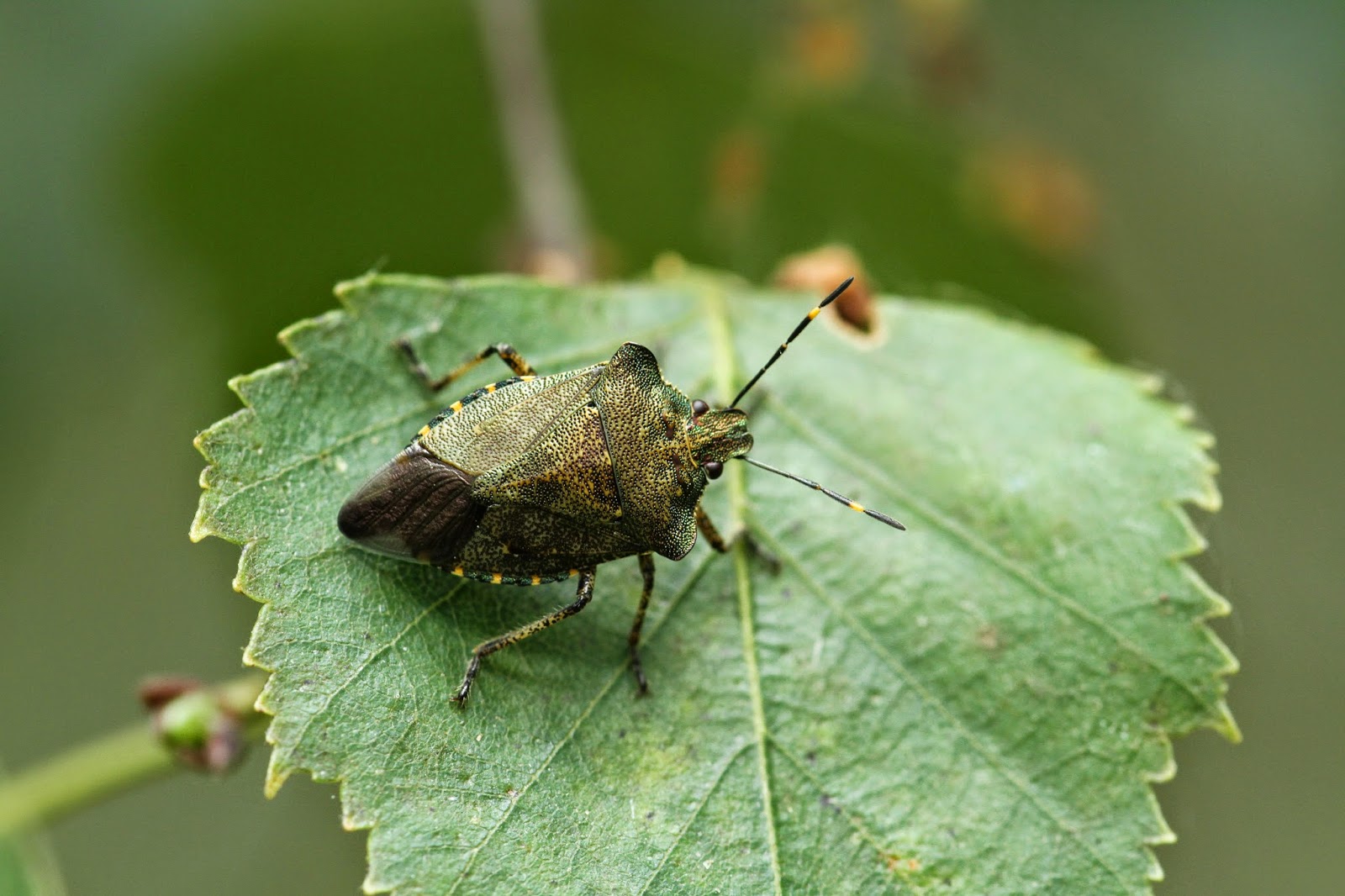
 Bronze Shield Bug adult - Skipwith Common - 18/08
 Bronze Shield Bug nymph - Skipwith Common - 18/08 

Birch Shield Bugs were far more numerous than Bronze, with at least 25 counted on this visit. As their name suggests they were primarily found on Silver Birch, but we also came across a number of individuals on Salix (willow species). Several nymphs were also found, with these being quite distinctive with their bright green and red markings. The adult bares resemblance to the Hawthorn Shield Bug, but is smaller and lacks the broad brown/reddish markings and has more of a bluey/green colouring. This species is likely to be found throughout woodlands, parks and gardens, the adults over-winter, before re-emerging in spring to lay their eggs, the new group of adults then start to appear from August onwards. Over the last few weeks there definitely seems to have been a sudden emergence on the Common.

 Birch Shield Bug adult - Skipwith Common - 18/08
 Birch Shield Bug nymph - Skipwith Common - 18/08
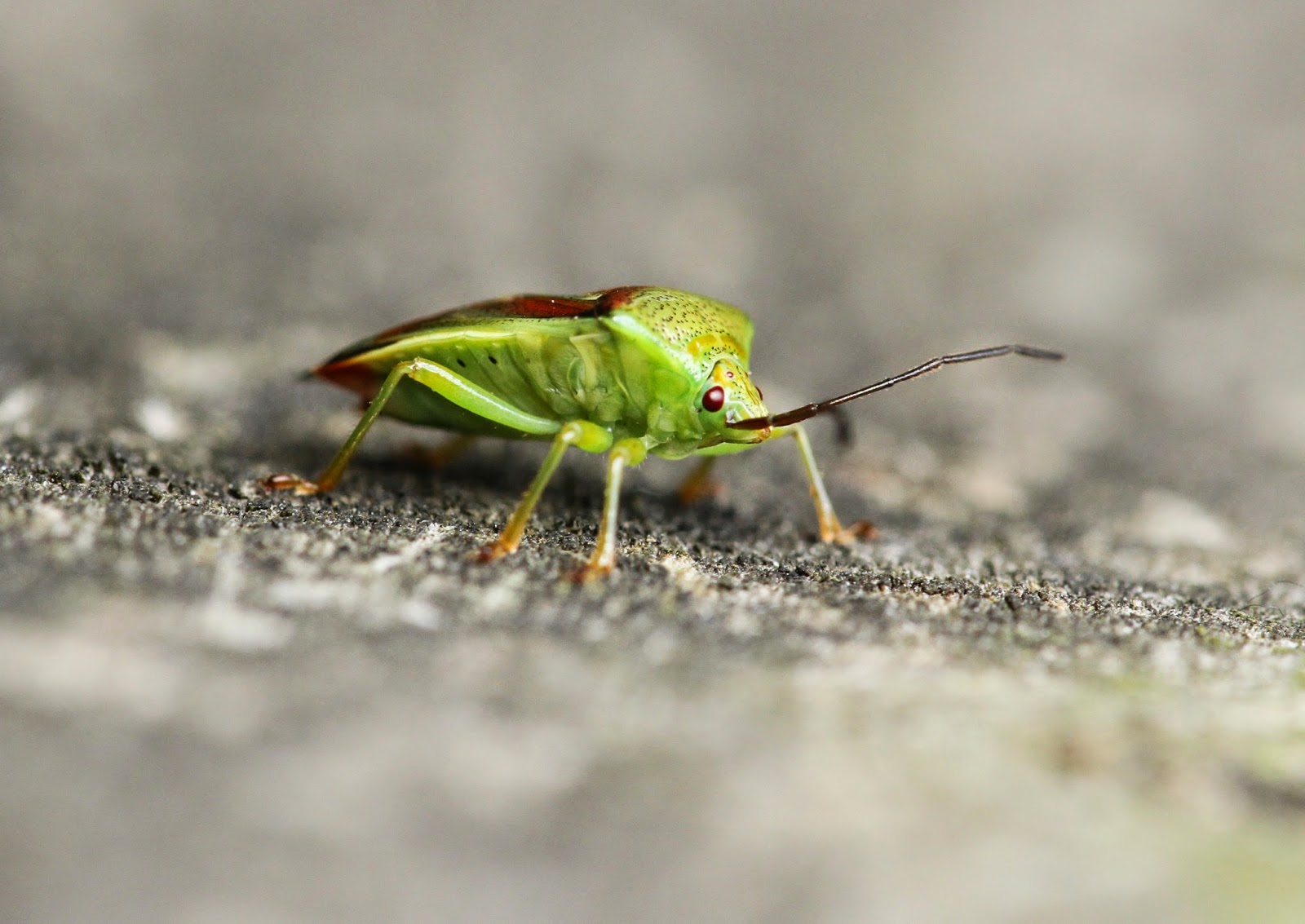
 
Birch Shield Bug adult - Skipwith Common - 18/08 

Nearby we searched the area of Gorse where we then came across Red-legged (or Forest) Shield Bug (Pentatoma rufipes) and Gorse Shield Bug (Piezodorus lituratus). Gorse Shield Bugs can be easily distinguished by the blue and yellow edge to the abdomen, and the dark purple/red colouring and bright red antennae. This species is likely to be found on heathlands, scrublands and commons, primarily where its food plants Broom and Gorse grow, the latter being where the majority of them were found, including many nymphs, pictured below. Earlier in the year during the spring this species is bright green with blue-edged wing cases, from August young adults then emerge with their purple/red markings, which darken prior to hibernation. We’ve seen a huge emergence over the last few weeks with high counts recorded, found singly on the Gorse (and also nearby Silver Birch), but also many were found in ‘clumps’ on top of each other.

 Gorse Shield Bug adult - Skipwith Common - 18/08
 Gorse Shield Bug adult - Skipwith Common - 18/08
 Gorse Shield Bug nymph - Skipwith Common - 18/08
Adults piled high - Skipwith Common - 18/08

The Red-legged Shield Bug was definitely one of the most striking species seen on this visit, and with its bright colours it stood out a mile amongst the Gorse, carefully balancing on the end of a spike with its long legs. Red-legs are a predatory species, which feed on caterpillars and other insects, as well as fruits. The adults can be seen occasionally in early spring, however usually from July until late autumn. This species over-winters as young larvae which are likely to be found mainly on deciduous trees such as Oak, Silver Birch, Alder and Hazel. This species has two colour forms, one with bright red-legs and antennae, the other has a much darker brown abdomen with a patterned yellow edge, and the pale spot on the back can vary between orange and cream. We were fortunate enough to come cross both colour variations on this visit, pictured below.

 Red-legged Shield Bug - Skipwith Common - 18/08
 Red-legged Shield Bug - Skipwith Common - 18/08
 Red-legged Shield Bug - Skipwith Common - 18/08
 Pair of Red-legged Shield Bugs - Skipwith Common - 18/08

To finish off, on the walk back to the van along the ditch side amongst the Juncus we found a single Hawthorn Shield Bug (Acanthosoma haemorrhoidale), unfortunately it flew off promptly so no photo! The Hawthorn Shield Bug is a bright apple green colour, with broad dark brown/red markings on the abdomen, the abdomen is also tipped red which helps to separate it from the similar Birch Shield Bug. The name suggests that this species will be found on Hawthorn, however we are yet to find it on Hawthorn, species such as Hazel, Holly, Oak and Dogwood are other hot-spots. They over-winter underneath bark, leaf litter etc and emerge in early spring, by late summer the new brood of adults emerge.

It was pleasing to find five species on the Common, and in good numbers, particularly Gorse Shield Bugs. Earlier that week we had also found Hairy (or Sloe) Shield Bug (Dolycoris baccarum) at Thornton Ellers and Green Shield Bug (Palomena prasina) nymphs, no adults as of yet, but with the number of nymphs recorded there should soon be a great deal of adults to look for. Hairy Shield Bugs are not as common as the others mentioned here, so to find two at Thornton Ellers this year has been a good result, and another new species for the valley. As their name suggests this species can be easily distinguished by the long hairs which stand out. They also have rather striking antennae with black and white markings, which also match the edges of the abdomen. Found both times on Bramble which is one of their favoured shrubs, however the larvae particularly favour Blackthorn and those in the Rosacea family. This species over-winters as an adult, emerging in the spring, the new generation of adults can often be found from August onwards.

 Hiding...
 & again....
 
Finally in the open - Hairy Shield Bug adult - T.Ellers - 26/08 

A number of Green Shield Bug nymphs were found in the same area at Thornton Ellers, with at least seven just along one hedgerow, usually on the nettle leaves. Green Shield Bugs are a bright green colour in summer, before turning to brown throughout the winter prior to hibernation. Another sap feeder they are likely to be found in parks and gardens on a variety of deciduous trees, but Hazel is a typically favoured species. Females appear in May, after hibernating in grass tussocks and leaf litter, by June they will have found a male to mate with. Females lay ‘batches’ of eggs, with around 28 in each, with a number of batches laid each female can lay up to 100 eggs, these go on to become the new generation of adults which we are likely to see from September onwards.

 Green Shield Bug nymph, 3rd instar - T.Ellers - 26/08
 Green Shield Bug nymph, 4th instar - T.Ellers - 26/08
 Green Shield Bug nymph, 5th instar - T.Ellers - 26/08

Over the last few weeks the Common has really been producing the goods with many other invertebrates found whilst looking for Shield Bugs - more on this another day!
 

Sunday, 31 August 2014

July round-up

Slow off the mark but worth the wait? The July sightings are now written up and online to read or peruse the photos, see the tab above or follow the link here. A full breakdown of all the bird species seen in the Lower Derwent Valley & Skipwith Common can be read on there, along with details of mammal, reptile, butterfly, dragonfly, moth, plant and other invertebrate records. Below is a brief summary of how the month un-folded, or click here for the full write-up.

July saw - the start of the autumn passage, the last of the breeding waders fledge and the final duck broods appear as the water levels receded. Wader passage was slow to begin with, and was as usual dominated by Green Sandpipers. A count of 84 Common Snipe on Wheldrake Ings on the 2nd may well have been local breeders, whilst seven Whimbrel passed through on the same date. A welcome highlight came on the 3rd in the form of a summer plumage Curlew Sandpiper at Bank Island. Eight Black-tailed Godwits and two Little Ringed Plovers on the 8th showed some concerted movement on that day, alongside a notable record of two Sandwich Terns heading south over Bank Island. 

Tufted Duck - Aughton - T.Weston

On the wildfowl front Egyptian Geese bred again and raised another brood in the East Cottingwith area, whilst a record breaking breeding season for Gadwall resulted in a count of 120 on the pool at Wheldrake Ings early in the month. A good showing of Grey Herons and Little Egrets took place whilst Water Rails were vocal and appear to have had a good season with two caught during the month. 

Water Rail - Wheldrake Ings - 16/07

Yet another Osprey passed through the valley on the 1st whilst Marsh Harriers were seen daily and a long staying Red Kite in the Melbourne area continued the general increasing trend whilst Kestrels, having had a productive season were widespread and numerous throughout the valley. As already noted in previous summaries Barn Owls have had a great year with nearly 200 chicks fledged from first broods and many incubating second broods again during the month.

Kestrel - Kexby - T.Weston

Throughout July as the bird interest settled down the invertebrate activity picked up the pace, another two Marbled Whites were recorded at Bank Island and large numbers of butterflies were recorded throughout the site. Dragonflies have had a good year with the majority of records coming from North Duffield Carrs and Skipwith Common, Black Darters in particular showed well at their stronghold.

Black Darter - Skipwith Common - 15/07

Moth trapping continued during the month with several new species appearing for the first time during the month including a fine Oak Eggar and Orange Footman at Bank Island, whilst True Lover’s Knot and Four-Spotted Footman were caught on Skipwith Common.

 Oak Eggar - NNR Base - 24/07

Plenty of new wildflowers, grasses, sedges and rushes were found throughout the month, such as Climbing Corydalis, Common Centaury, Cotton Grass, Flowering Rush, Marsh Pea, Musk Thistle, Pale Persicaria, Round-leaved Sundew, Scarlet Pimpernel and Trifid Bur-marigold.


Musk Thistle - Thornton Ellers - 07/07

A number of other new inverts were found throughout the month – grasshoppers, wasp mimics, hoverflies, beetles, shield bugs and more - for more information follow the link above.

Longhorn Beetle Leptura quadrifasciata - Skipwith - 21/07

Thursday, 28 August 2014

24/08/14 - Eyes down, hand lenses at the ready

Earlier in August expert botanist Judith returned once more to the valley, after initially joining us throughout the Long Term Monitoring Network last summer and then later returning for several training days. The aim of the day was for us to build on what we learned last year, refresh our ID skills and to look for new species – it also provided the opportunity for Hannah to join in – our newest member of the team – currently studying at Askham Bryan College and volunteering for us one day a week throughout her course.

Armed with our hand lenses and books we headed down to Thornton Ellers first off where we decided to spend the morning, and searched for the species that we found there last year – and came across new ones along the way. Thornton Ellers is a diverse site - an Alder Carr woodland with a peat based fen and meadow, and adjacent post glacial sand dune - an interesting range of habitats together.


Twenty three new grasses, sedges and rushes for the year were found such as Sharp-flowered Rush, Velvet Bent, Heath Wood-rush, Purple Small-reed and Brown Bent. Many of the commoner and more easily recognisable species were still present although not many in flower, such as Yorkshire Fog, Soft Rush, Sweet Vernal Grass, Tufted Hair Grass and Toad Rush to name but a few.

 Sharp-flowered Rush Juncus acutiflorus
Yorkshire Fog Holcus lanatus

Plenty of wildflower species were scattered throughout the wet meadow however the large patch of Devil’s-bit Scabious had the greatest variety with many species growing amongst it such as Marsh Violet, Fen Bedstraw, Lesser Spearwort and Marsh Cinquefoil.

Devil's-bit Scabious Succisa pratensis

Following the woodland edge and leaving the wet meadow behind we came across species such as Yellow Loosestrife, Greater Bird’s-foot Trefoil, Common Hemp-nettle, Purple Loosestrife, Water Pepper and Marsh Woundwort.

 Water Pepper Persicaria hydropiper
 Common Hemp-nettle Galeopsis tetrahit
 Purple Loosestrife Lythrum salicaria

Along with the wildflowers and grasses there were also plenty of insects to have a good look at, Common Darters and Brown Hawkers buzzed along the hedgerow, Small Skippers, Meadow Browns and Peacocks were making good use of the Devil’s-bit Scabious and Gatekeepers were feeding on the few remaining Bramble flowers.


 Common Darter Sympetrum striolatum
Small Skipper Thymelicus sylvestris

Many of the Helophilus hoverflies were also feeding on the Scabious, largely Helophilus pendulus, amongst them we also spotted one of the wasp mimics – Chrystotoxum bicinctum. A 22-spot Ladybird and Sloe/Hairy Shield Bug were found on the walk back along with at least 10 Red-breasted Carrion Beetles which were feeding on an old Partridge egg.

 Wasp mimic Chrystotoxum bicinctum
 22-spot Ladybird Psyllobora 22-punctata
 Field Grasshopper Chorthippus brunneus
Sloe/Hairy Shield Bug Dolycoris baccarum

After several hours well spent in the meadow we headed off and stopped by the Pocklington Canal for lunch, and revision on all the grass species we had found throughout the morning!


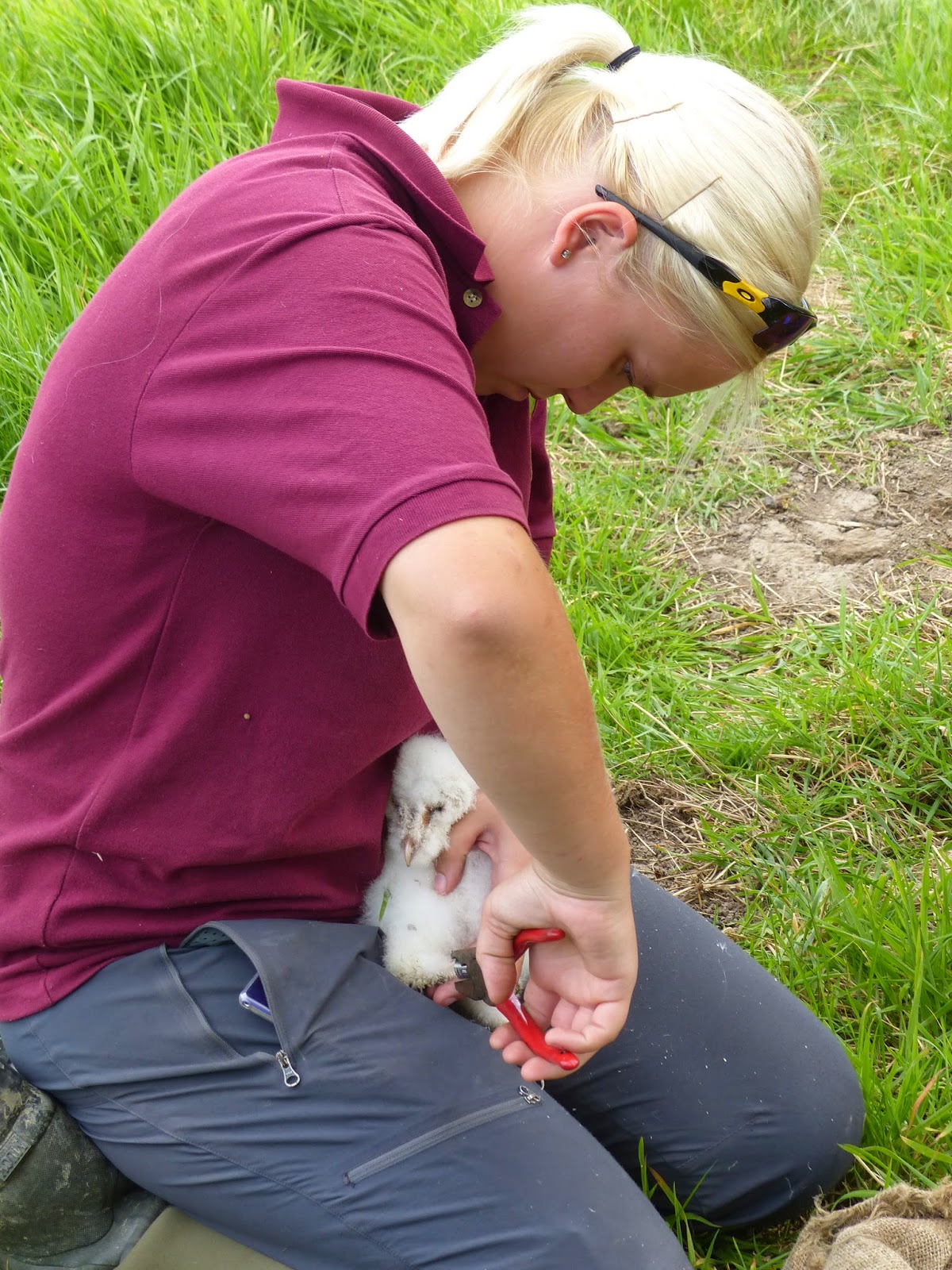
On the way to the next location we stopped off at Aughton to ring a brood of Barn Owl chicks that we knew should be ready to ring - seven weeks ago when checking for second broods we found six eggs from a pair that had already produced five young. Five chicks were present in the box, all of a ring-able size bar one.


From there we headed to Wheldrake Ings where we spent an hour in the meadow near Swantail Ings, here we came across a number of grasses and wildflowers such as Bladder Sedge, Slender Tufted Sedge, Marsh Speedwell, Water Dock and Trifid Bur-marigold - some which were new for the year and taking us to a day total of 127 species from the two sites.

Trifid Bur-marigold Bidens tripartita

We also came across two ladybirds which were new for the year, the Harlequin Ladybird (form H.spectabilis) and the common 2-spot Ladybird. Many of the Helophilus and Sphaerophoria hoverflies were making the most of the Water Mint, Purple Loosestrife and Trifid Bur-marigold which are all now in flower across the Ings.


 Harlequin Ladybird Harmonia axyridis spectabilis
Hoverfly - Helophilus trivittatus

Overall a very enjoyable day with a great deal learned about a whole range of species. We look forward to Judith's next visit which will cover the plants of Skipwith Common.

Saturday, 2 August 2014

Summer - Work on the NNR

A few snippets of how the last two months have been spent in the Lower Derwent Valley. 

Each year from the end of May, throughout June and into July week after week is spent pulling Marsh Ragwort from the meadows around the valley.


Marsh Ragwort is a plant of wet grassland, often occurring in un-improved wet hay meadows, along with more improved wet grassland. Marsh Ragwort is toxic to livestock due to the compounds it contains. However, grazing animals usually tend to avoid it but cattle have been known to graze the flowers, and sheep will eat the leaves when they first appear in a rosette form. The majority of the meadows in the valley are cut and baled for hay and so the Ragwort needs to be removed before the farmers can cut the meadows, it is thought that once dried and mixed in with the other plants it becomes more difficult for the animals to avoid.


So each year we have to ‘pull’ all the land owned by NE which is c500ha and requires a lot of time and effort! So many thanks to the staff and volunteers who have tirelessly worked over the last few weeks filling countless numbers of bin bags and skips!

Spraying and the complete removal is believed to be the only way forward by some. However Marsh Ragwort is a native and natural component of species-rich wet hay meadows, and unfortunately (at the moment) there isn’t a spray or other method of control that would selectively take out the Ragwort without it affecting the rest of the wildflowers. 


Since the ragwort 'season' finished we've moved on to sorting out all the paths around Bank Island and North Duffield Carrs, along with trimming back the vegetation from around the pools in anticipation of the waders and ducks returning as autumn approaches. By clearing the vegetation it make the pools more open and therefore more attractive for passage waders dropping in on autumn migration. It also stops species like willow from becoming established and shading out flowering plants such as Water Mint, Corn Mint and Purple Loosestrife which provide valuable nectar sources to many invertebrates.


Whilst busy strimming we've been seeing plenty of Emerald Damselflies and Ruddy Darters resting on the Soft Rush, whilst the Brown Hawkers and Emperor Dragonflies have been out hunting across the water. 


Along with the usual team we've also had extra help during the last four weeks, with two students on placement, first off was fifteen your old school boy Adam who spent an enjoyable two weeks here on his work experience placement. His time was spent between a variety of tasks such as helping us pull Marsh Ragwort from the meadows and Himalayan Balsam at Thornton Ellers, a sheep round-up on Skipwith Common, checking the Barn Owl nest boxes and then on his last day helping us catch and ring the broods of Mute Swans at North Duffield, Wheldrake Ings and the Pocklington Canal – made easier by his superb canoeing skills! Sam then joined us for the last two weeks, and was a big help with strimming the paths and clearing large areas of Himalayan Balsam. It's been a real pleasure having them both on board for the last few weeks, we now wish them well in their final year at school and hope to see them both again in the valley soon!


Since ringing the last of the first broods of Barn Owl chicks in June, things have largely been quiet on the ringing front, mainly due to the amount of work and lack of time to do it in. However after a morning pulling several members of the ragwort team were rewarded with close views of this male Sparrowhawk which had flown into one of our duck traps that had been left un-set, meaning it could fly in and out as it pleased, but we were swift enough to close the door on arrival. Not many Sparrowhawks are ringed in the Lower Derwent Valley each year so it was pleasing to see this small male at close range. With their bright yellow/orange eye, piercing looking bill, long legs and needle-sharp talons they look like they mean business! Sparrowhawk’s are adept hunters of passerines and with their relatively short rounded wings and long tail they are adapted for nimble manoeuvring through woodlands and trees, where they will prey on flocks of mixed tits and finches. 


Sparrowhawks breed in woodlands but are a regular visitor to towns and cities and often appear in gardens – where they will hunt their prey by skimming hedges, rooftops and gliding low over the ground before swooping through with lightning speed and ambushing an unsuspecting individual. Sparrowhawks usually tend to stay out of sight until they are ready to strike, one of the first signs that one may be in the vicinity is that of the alarm calls of small birds – who are alerting others nearby to the danger.

As with most birds of prey the females are a lot bigger, so we were able to sex this bird by looking at the size. The grey/blue colouring on the back is typical of an adult of at least two years, although it could be an older bird – especially with such a bright eye. This year’s Sparrowhawks are just beginning to fledge – they breed later than most other birds to coincide the hatching of their eggs with the fledging of small passerines – meaning an abundant food supply!


After a day pulling Ragwort, some of the team decided to stay late into the evening and ring in the reed bed on Wheldrake. A total of 61 birds were caught, including Sedge and Reed Warblers, Reed Buntings and 40 Swallows that had come into roost. However a highlight came in the form of this beauty – a juvenile Water Rail. 

Water Rails have had a good breeding season on Wheldrake Ings with five calling males regularly heard (they are seldom seen so recording the singing males is the best way of estimating the population). We know at least one pair bred raising two young as the chicks have been seen in front of Swantail Hide. Interestingly an adult female was also caught and ringed when pushing our corale trap for ducklings last month - she had a brood patch and had presumably also bred. These are first two Water Rails to be ringed in the valley for a few years, bringing the number ringed on site to 49.


Mute Swans appear to have had a better year than those of late, with seven pairs nesting across the Lower Derwent Valley. However, brood sizes have been mixed ranging from two broods of two and the largest of nine. This year three broods have been caught in the LDV, with broods of two on Wheldrake and North Duffield and a brood of five on the Pocklington Canal. Several new adults have also been caught with each one fitted (and the cygnets) with one of our red and white darvics.