Welcome to the LDV NNR ringing blog, this blog is designed to share the experiences, findings and tales from a group of dedicated ringers. We specialise in conservation orientated research projects, largely focusing on wildfowl, waders, owls and birds of conservation concern, in and around the Vale of York NNR's.

NB - Whilst the purpose of this blog was initially designed to cover our nationally important wildfowl ringing activities, it now also features wildlife and work posts, explaining how we manage the NNR for both wildlife and people.

For daily sightings please visit our Twitter account: https://twitter.com/ldv_nnr (@LDV_NNR)

For details of events, volunteer tasks and wildlife images please visit our Facebook account: https://www.facebook.com/Lower-Derwent-Valley-Skipwith-Common-NNR

Thursday, 16 July 2015

16/07/15 - Summer work on the NNR

The summer months on the Ings are our busiest time, with most days spent hand pulling Marsh Ragwort from the valleys meadows. Whilst busy with the ragwort we've also been: strimming all the paths to allow visitors access to the hides, cutting the meadow at Thornton Ellers, surveying and assessing the condition of the Ings, running events, repairing paths, extending boardwalks, helping Escrick Park Estate with the sheep round-ups, controlling birch scrub and so on - so it's been all hands to the pumps in the LDV. Below are a few snippets on how the last six weeks have been.


  East Cottingwith - June 2015

As mentioned earlier at this time of year the LDV team are busy hand pulling Marsh Ragwort from the meadows. Ragwort is a natural component of the meadows, but is toxic to livestock when dried in the hay. Although it is not as toxic as Common Ragwort, which is more commonly seen throughout the countryside including road verges and waste ground, and which flowers later. Unfortunately there aren’t many ways in which we can tackle this problem – hand pulling being our only option to remove it completely from the meadows, thus making the land viable for the local farmers to make a hay cut, whilst ensuring the traditional management of the Ings continues as it has done so for over a thousand years.

Hand pulling Marsh Ragwort

Whilst pulling ragwort can be hard and rather repetitive work, particularly in extreme weather – heavy downpours and a heat wave lately, it is also unfortunately a nightmare for hay fever suffers – which the team is largely made up of! However the meadows are a lovely place to be, amongst the wildflowers, breeding birds and insects – apart from the Horse Flies of course which can leave a rather nasty bite – so many thanks to our team for getting stuck in and doing such a great job! 

Black-horned Cleg 

Following on from our surveys at Forge Valley Woods in June, we’ve been out in the meadows during the last few weeks carrying out similar surveys to assess their condition. It’s certainly been a good year for the meadows following a couple of more ‘traditional’ summers, along with all the hard work managing the site over the last few years, and the relatively dry winter and spring we’ve just had.

The meadows are full of herbs such as – Meadow Buttercup, Pepper Saxifrage and Yellow Rattle, along with these common species there’s also been plenty of Marsh Orchids at East Cottingwith. Some of the rarer species have also fared well with good numbers of Narrow-leaved Water-Dropwort, whilst other local species in the meadows include Common Bistort, Quaking Grass and Marsh Valerian. Whilst the flower rich communities have expanded, the species poor areas - sedges and rushes - have retreated, and the meadows have been judged to be in favourable condition – another great result.

Orchid Field - East Cottingwith

Whilst out in the meadows we’ve also been recording breeding birds, butterflies, dragonflies and other invertebrates, Banded Demoiselle’s have been showing particularly well lately whilst counts of Meadow Browns have been in the hundreds!

Meadow Brown pair 

At the end of June some of the team were out on Skipwith Common surveying plants, and learning tips on how to identify some of the tricky grasses with help from expert botanist Judith. Once again we were blessed with good weather, with temperatures soaring high at 28 degrees. On arrival the Common hummed with activity, with young Great Spotted Woodpeckers heard calling and juvenile Woodlarks feeding on the heath, whilst a flock of Siskins called from the tree tops.

We set about our task for the day and spent the morning searching the heath for different species of grasses, sedges and rushes, with a few mosses and lichens thrown in along the way. We managed to find – and remember – a number of species from last year which was pleasing, whilst also finding new species for the site, such as Slender Rush and Bristle Club Rush. New mosses were also found, however with the Common being particularly dry at the moment, many of the species are suffering. 
 
Moss hunting with Judith 

Whilst looking for plants we were also keeping an eye out for invertebrates, with many Large Skippers and Meadow Browns seen, along with the first Ringlet and Red Admiral of the year. Several Longhorn Beetles were also found on the newly opened bramble flowers. No Adders were seen - they’d probably already moved off due to the temperatures being so high, however we did literally stumble upon this one the previous day, coiled up out in the open – something we don’t often see. Many thanks to Judith for her novel teaching techniques and useful ways of helping us to identify some of the many grasses that the Common has to offer! 

Four-banded Longhorn Beetle - Skipwith - 30/06
 
Adder - Skipwith - 29/06

Recently we ran a successful Barn Owl event at the NNR Base, in conjunction with the Yorkshire Wildlife Trust. Despite the heavy rain early on, plenty of visitors and locals arrived at the base and took part in various activities - quizzes, arts and crafts, pellet dissection, bird ringing, moth trapping and pond dipping. Jean also brought in a Barn Owl for the children to get a close view of, along with an orphaned Little Owl chick which was on its way back in to the wild. Once the rain cleared more people came out to play, along with one of the local Barn Owls which hunted over Bank Island throughout the afternoon. 

So despite the wet start a successful day, and great for us to see the next generation getting enthused about ‘our’ owls, and the other amazing wildlife around the Lower Derwent Valley – thanks also to Jean, our partners at the YWT and our own staff and volunteers who helped out and made the day a success.


Pictured below is the Little Owl Jean brought in, sadly it was found sitting next to its dead mother at the side of a road in Malton, presumably the unfortunate victim of a collision as she perhaps hunted for road causalities herself – the edges of roads often provide a good supply of dead insects such as bees, beetles or other larger insects as they deflect off car windscreens.

Fortunately for this little chap he was picked up by a kind passer-by and spent a couple days at Jean’s recovering and feeding up. On the day of release back into the wild, Jean brought him to the base with her in the morning to show some of the children for our ‘owl weekend’ and then took him to a site in Thixendale to be re-homed – where he was safely put into another nest of a Little Owl family (where the chicks were at the same stage). The nest is monitored by cameras, and so we already know that the adults have taken to their newest addition and have started to feed it along with their brood. This is a great result and another job well done, thanks for sharing it with us Jean and also for allowing some of the children to experience one close up before you returned it to the wild.


Little Owl  

Last month several of the team were busy working with the local primary school at North Duffield, showing them the delights of freshwater life! 31 pupils braved the blustery weather for a morning of pond dipping in the scrape by the Geoff Smith Hide. On their arrival they were greeted with hundreds and hundreds of tadpoles, as if that wasn’t enough excitement, our intrepid explorers went on to find a rather impressive Water Scorpion - an interesting creature which uses its spindly ‘tail’ as a snorkel. More discoveries soon followed, with ramshorn snails, spiders, pond skaters, diving beetles and mayfly nymphs all found. Many thanks to Phil & James for showing the children the different creatures, and thanks to all the pupils for really getting stuck in and enjoying getting closer to nature!


Pond dipping at North Duffield Carrs

Lately we’ve also been continuing our work alongside Ad Astra at the NNR base, helping to engage and train a new generation of naturalists. The young 'lads' have been working with Phil (our NNR apprentice), and have got stuck into checking the moth trap, bird monitoring and recording the invertebrate life in our garden pond along with a bit of pond dipping. This is part of a larger project to record the diversity of our wildlife garden and to help build and install a ‘bug hotel’. The group are also working with Phil to help interpret our work in the garden for the enjoyment and education of other visitors to the base.

The bug 'hotel' contains plenty of dead wood of various sizes, for use by some of the invertebrates that use the garden, such as the Long-horned Beetles we’ve mentioned lately. Sections have also been packed with hollow stems and wood with drilled holes to provide suitable locations for Mining Bees and other hole-loving insects.


One of the highlights for the guys was finding Smooth Newts and a number of adult Great Diving Beetles, pictured below. Many thanks to everyone for their enthusiasm and for doing such a good job!
 
Great Diving Beetle

Tuesday, 14 July 2015

12/07/15 - Snipe delight

Lately the ringing pliers haven't seen much use, usually at this time of year we're busy carrying out nest box checks and ringing young Barn Owls and Kestrel broods. Unfortunately this year is proving to be a rather unsuccessful one, with to date just two broods of Barn Owls and one brood of Kestrels ringed so far. Compared with this time last year, we'd just ringed the 117th Barn Owl chick and 57th young Kestrel - more to come on this below.

Ducks also seem to be having a poor season in the valley, with just three broods of Gadwall and one brood of Shoveler and Tufted Duck seen so far this year. Waders on the other hand seem to have fared better, with a number of young Curlews, Redshank and Lapwing chicks seen in the meadows. Snipe also breed in the meadows but are rarely seen, however last week whilst the team were out hand pulling Marsh Ragwort, this little newly hatched Snipe chick was found. Whilst it isn’t unusual for the teams out in the meadows to come across wader chicks or other breeding birds, nests or young, in recent times Snipe chicks have been quite scarce. Numbers have sadly declined over the last 20 years, much in line with the national population, and probably made worse locally by several summers with unseasonal flooding. However, numbers have increased again this year with up to 40 drumming males or pairs. This little chick was quickly ringed and returned to the meadow – wader chicks are largely independent, leaving the nest and feeding themselves as soon as they hatch. Hopefully this one will go on to fledge successfully and further add to the local breeding population in future years.

Snipe chick - 23/06

No ducklings from the Ings have been ringed so far this year due to it being such a poor year, however a brood were ringed and released on the reserve last month after nesting in one of the local gardens! The owners had watched as the female laid her eggs, incubated them and the ducklings hatch, and had been looking after them for five weeks - doing a great job in providing them with food and access to plenty of water via two of their children’s paddling pools! But due to a change in circumstances and a worry that they might be at risk from predators, they needed to be moved out of the garden, and with no easy access out of the small enclosed courtyard garden they were unable to get out themselves. After a successful round-up of all 10 of them, they were ringed at the office before being released on to Bank Island, where they took to the ditches and joined up with some of the other broods. There is a real mix of ages present at the moment across the site, ranging from the small ‘bumblebees’ as they are affectionately named, to some that are almost already fledged.

Mallard duckling - 18/06

As mentioned above, Barn Owls and Kestrels don't appear to be doing well this year, there are several theories as to why this has happened, our regular followers on here may remember at the beginning of the year (throughout February and into spring), that day time hunting Barn Owls were a daily occurrence on the Ings – something which you wouldn’t expect to see usually. It was believed that the owls were struggling to find enough food through darkness, with them resorting to hunting during the day.

Last year we know the vole cycle crashed during the winter, as they can do periodically, being very cyclical, and although we didn’t have a particularly harsh winter and the birds were able to hunt, it did mean unfortunately that they were struggling to find food, and we sadly picked up half a dozen starving or dead individuals – most birds however did survive the winter but weren’t able to obtain good enough body condition in order to breed. Putting energy into producing eggs, incubating them for four to five weeks, brooding chicks for another three, and feeding them for another six or seven is quite a big energetic expense on the females. Whilst the vole cycle is now likely to be recovering gradually, it is interesting to note that the few pairs we have heard about locally as rearing broods have, all bar one, been supplementary fed – with kind farmers and landowners providing additional small mammals and dead day old chicks.

Barn Owl brood - 2014

Barn Owls often produce second broods so it's not unusual to find chicks in August, but unfortunately it's got to the point now when the birds are running out of time to breed, but this ‘year off’ is likely to have little impact on the local or wider population following last year’s bumper season. 

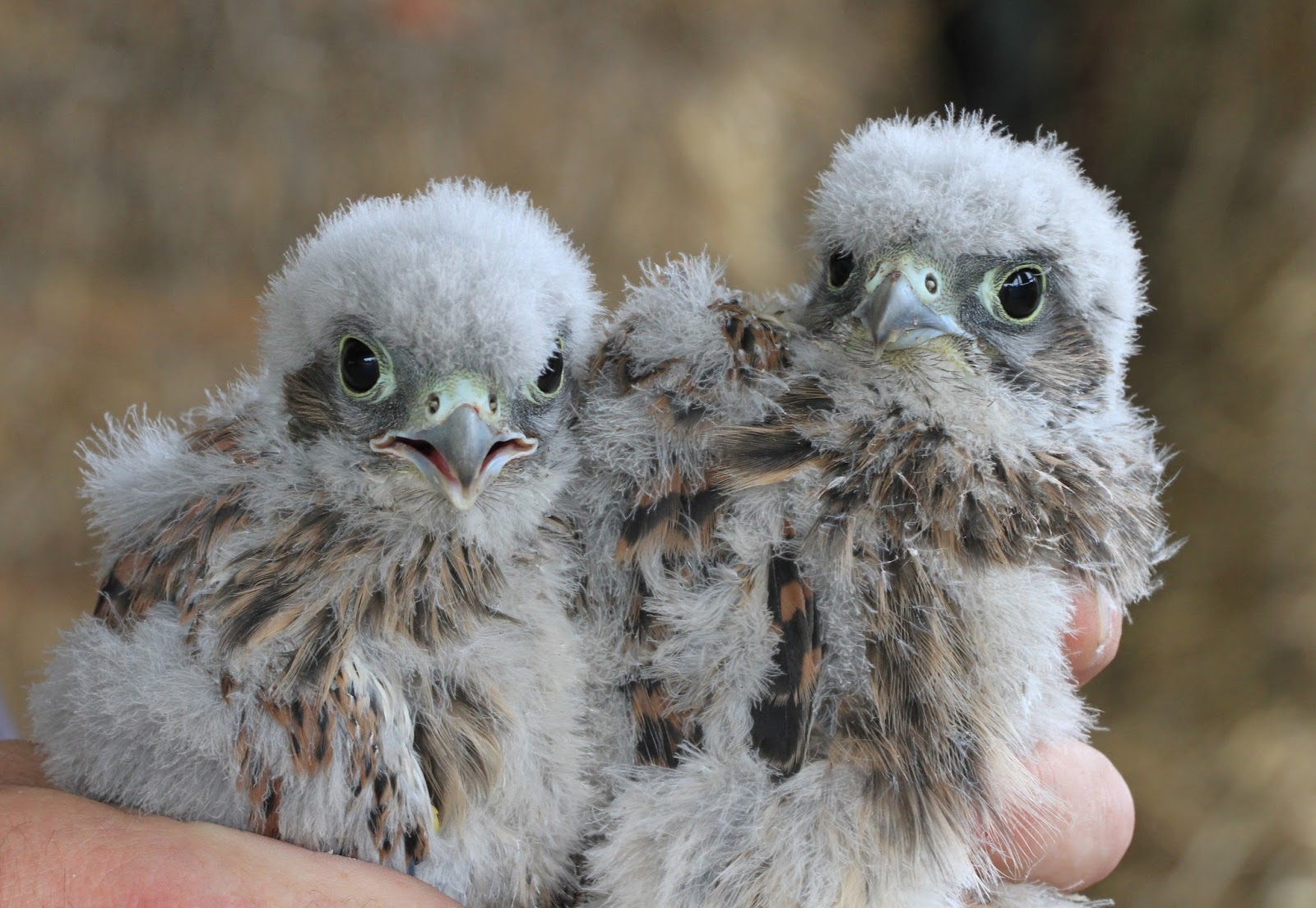
Kestrels also seem to be struggling to breed, although have fared a little better than the owls as they can more readily switch to taking other prey and especially small birds. Last week a brood of three (first for the year), were ringed near Skipwith, at a reliable site high up in the roof of an old barn (and one that has produced chicks for the last four years at least). This included two females and a male, which can be separated at this relatively young stage by their tail colour – the males having a grey band and the females being all brown. After suspecting that many of our birds have been struggling to find enough food, particularly voles, it was interesting to find a number of small birds on the ground below this nest – including the remains of a Dunnock and Reed Bunting tail feathers.


Kestrel brood - male (l), female (r)


Wednesday, 24 June 2015

22/06/15 - Goose round-up

At the beginning of June our team of staff and volunteers undertook the annual goose round-up at Wheldrake Ings. With a big team needed and a dawn start, we were grateful that our volunteers were willing to come in early, with the only promise being of getting wet and muddy with hopefully a few birds caught along the way! At this time of year the young geese are unable to fly and many of the adults are also flightless, with their feathers currently in moult, this means that we are able to herd the birds across the site and onto the pool before trying to head them in the direction of the corale – a small pen where they are ringed. Doing a yearly goose round-up allows us to ring a good sample of the local population each summer, and helps us to monitor their movements and see how local breeding birds interact with the 2000+ wintering birds that visit the site between November and March.

A reasonably successful catch saw a total of 35 birds caught and ringed – 32 goslings and 3 adults, whilst we also re-caught another adult from the 2013 round-up. The following day a further nine were picked up in the meadows, which brings us to a total of 44 birds out of the 60 goslings and 20 adults present.


A total of 777 Greylag Geese have now been ringed in the Lower Derwent Valley NNR – which have produced a number of recoveries and movements over the years, with birds ranging across Yorkshire. From the recoveries we’ve noticed that birds seem to move east into East Yorkshire and Holderness whilst many others also seem to head north-west, particularly into the Ripon and Harrogate areas. Several have also been recorded in Scotland with birds seen at Loch Leven and Caerlaverock. 

Following the goose round-up, we then headed to the pool to ring and release the first of Jean's birds that were ready to go back into the wild. Several weeks ago we posted about a lucky Mallard duckling which, unlike its mother and siblings, survived a motorist in a rush and ended up in Jean’s care as a little orphan. 


Since then it has been joined at Jean’s by 30 other orphaned, lost or abandoned ducklings and goslings. After several weeks in Jean's care, a group of 15 Mallards and 3 Greylags were ready to be ringed and released on the reserve, with them now being large enough to fend for themselves.

It’s always such a pleasure to see them paddle away, excited to be back in the wild. We watched as they began tentatively exploring, and enjoyed bathing and splashing in the water with much excited calling. Within minutes of release they looked and acted just like any other of the naturally reared broods on the reserve – and we know from ringing them that they generally go on to survive as you would expect from naturally reared broods. So well done again to Jean – another great job. 

Monday, 22 June 2015

20/06/15 - Spring visit to the heronry

During the middle of last month the team made the annual visit into the local heronry to colour-ring a sample of the Grey Heron chicks. This was the second visit into the heronry, although the first chicks of the year - on our first visit we found all the nests had failed shortly after the young chicks had hatched. It was suspected that the young chicks were predated by the pair of Red Kites that had set up residence in the heronry. Fortunately (for the herons), the pair of Red Kites had moved on by the time the adults had re-laid, and so on this visit we were able to fit colour-rings to 21 chicks that were carefully lowered to the ground by our colleagues at Lewis Tree Surgery. 


All the chicks appeared to be a good size with some of the largest not that far off fledging, so keep an eye out for the first young appearing on Wheldrake in the next week or so. In total 28 active nests were recorded for the long running BTO heronry census.


Ringing in the heronry over the years has shown that soon after fledging the young tend to disperse north into North Yorkshire, Cleveland and Northumberland, although one bird headed south last summer into Derbyshire. There are two foreign interchanges with the valley from ringing studies – both birds were ringed as nestlings in the Netherlands in the early 1970’s and found here. Please let us know if you come across any colour-ringed birds which will help us build up a bigger picture of their movements.

Thursday, 4 June 2015

02/06/15 - Magic May

Throughout the last month we've been busy recording wildlife on the reserve whilst we've been carrying out the day to day jobs around the site - follow this link to the last post to see what's been happening on site recently.

Below are a few snippets on some of the wildlife that we've seen, late April/early May can be delightful months with the emergence of many of our invertebrates, however this year we haven't seen the best of the weather, especially in comparison to last spring, although we have had our first sightings of Orange Tip and Holly Blue butterflies, Large Red Damselflies, Banded Demoiselles, 4-spotted Chaser Dragonflies, and birds such as Common Cranes, Short-eared Owls, Little Owls, Turtle Doves and Cuckoos have been pleasing finds. The first young chicks of the year have also made their first appearance, with three Little Grebes hatching on a pond in East Cottingwith along with two Oystercatcher chicks, whilst several Lapwing and Redshank broods have also been noted on the Ings. Plenty of our flowering species have also been recorded this month, with species such as Adder's-tongue Fern, Green-winged Orchid, Bugle and Ragged Robin all noted.  


At the end of April (21st) we came across the first damselfly of the year, when four Large Reds were seen on ‘Adder Heath’ and around the Bomb Bay Loop. This species is usually first found in May, with the first records from the previous two years being on the 19th May in 2014 and the 22nd May in 2013. So this is almost a month earlier than we were expecting compared with the last two years. Large Reds are the first of the damselflies to emerge in the UK, with the first records appearing from the end of April across the country. Perhaps the warm weather at the end of the month brought forward their emergence, it certainly brought out a flurry of butterflies on the Common, with 11 Orange Tips, 4 Peacocks, 3 Brimstones, 1 Small Tortoiseshell and 1 Comma all seen, along with the first Speckled Wood of the year at Bank Island.

Large Red Damselfly - Skipwith Common 

Orange Tip are a butterfly which can usually be difficult to photograph as they don’t pause on flower heads for long periods of time, or bask in the sunshine compared with some species such as Peacocks and Small Tortoiseshells. A typical view of an Orange Tip is a flash of orange (on the males), as they flit past you, disappearing from sight as quickly as they appeared. However at the end of April/early May we were treated to views of a number of individuals on the Common as they paused on some of the few Bittercress flowers that had already opened. They didn’t stop for long, but with ten different individuals stopping for nectar at this one flower head, and a bit of patience we came away with this photograph which really shows off the mottled green underwing.

Orange Tips are a true sign of spring, with them being one of the first species to emerge having not overwintered as an adult. If you haven’t seen one yet keep a good look out for them and enjoy them while you can as they are one of the butterflies with a shorter season, usually being seen in April – May and into June. The lane down to the car park at Wheldrake Ings is a good place to see them, and along with the riverside track at Bank Island where one of their larval food plants, Garlic Mustard can be found. 

 
Orange Tip - Skipwith Common 

One of the other butterflies that we recorded in May in the Lower Derwent Valley was the Holly Blue, which is not a particularly common butterfly on the Ings - only a single individual was noted last year in 2014. They are more often than not found in local villages where their two key food plants – Holly and Ivy, are more readily found. This butterfly is unique amongst British butterflies in having two different food plants at different seasons – using Holly in the spring and Ivy in the autumn, although the caterpillars are also known to feed on Bramble, Dogwood, Spindle and Gorse.

 
Holly Blue - Melbourne 

Lately as we’ve been out and about in the valley undertaking management and surveys, we’ve encountered several of these little ‘bugs’ – Red and Black Froghoppers. Whilst not one of the commonest species of froghopper out there, it is one of the more unmistakable with its bright colours, and at 1cm long, it is one of the largest. It can be found commonly across much of Britain from April to August – just in the last few weeks there seems to have been a large emergence around the valley. The adults feed by sucking the sap of many plant species - we’ve been generally coming across them on Hogweed, although they can also be found in a wide range of habitats from grasslands, woodlands and meadows. The adult’s ability of suddenly ‘jumping’ off in response to danger or a threat gives them their rather appropriate name.

Red & Black Froghopper - Melbourne

Skipwith has been a great place to watch butterflies and dragonflies lately, however it has also been providing us with continued sighting of Adders on the heath.

Adders are known to be present on the Common, however this hasn’t always been the case. The interest in reptiles on Skipwith has only been developed over the last 15 years or so – prior to this time species such as Adders and Grass Snakes were relatively scarce on the Common. Work over the last 30 years by Escrick Park Estate and Natural England has seen areas of woodland and birch scrub cleared, to help regenerate more of the open wet and dry heath for which the site is nationally important. Further fine tuning of the management since the site became a National Nature Reserve in 2009 has seen the provision of more reptile refuge and hibernacula to further boost numbers, and a greater awareness of this interest to allow more people to enjoy the Common’s reptiles – let us know if you’re lucky enough to see any on your visits by filling in the sheets in the boxes provided.
 
Adder - Skipwith Common

Brown Hare sightings have been less frequent during the last few weeks, however until then sightings were an almost daily occurrence, both on the Ings and surrounding farmland. Following the annual ‘boxing’ mating rituals in February/March, hares then start to pair up, with breeding taking place between February – September. The females can have at least three litters during this time, with two to four leverets born on each occasion. Sightings of leverets have been noted in previous years from June, with Wheldrake Ings and North Duffield Carrs being favourable spots to see them in the past. Once the leverets have been born they are often left alone in the grass throughout the daytime (to hopefully avoid attracting predators), the female then returns in the evening and gathers her young around her to feed. The young are left in what is known as a form, this is also a place where the adult will rest, usually before laying down the hare will scrape away the vegetation making a shallow depression. Forms are often made in the shelter of a grass tussock or next to a stone which will give protection from the wind. The female will choose a suitable form to give birth in, and will line the bare ground with fur from her coat.

This stunning individual was captured on camera recently at North Duffield Carrs by local birder/photographer Mark Hughes. 

Brown Hare - North Duffield 

The end of April saw the arrival of Turtle Doves and Cuckoos, with the latter reported numerous times from a variety of sites throughout the month (see recent sightings). The gentle purring call of the Turtle Dove from high amongst the canopy of the trees from late April/early May signals the return of this species - our only migratory dove from its wintering grounds in Africa. Like the Cuckoo, the Turtle Dove has undergone a dramatic decline throughout the British countryside, which has been mirrored across the Lower Derwent Valley. A mere four records were reported in the area during 2014, however this year three birds have already been noted - a pair have been present near Foggathorpe and another single has been heard near Skipwith Common. This is a far cry from the flocks recorded in the 1970’s and 1980’s which included a flock of 45 at Escrick in 1978,  while an influx between the 22nd April and the 8th May brought more than 50 birds to the valley in 1983. 52 pairs were still present around the valley as recently as 2000 but numbers have continued to plummet. This individual was captured on camera by local birder John Heaton who was fortunate to come across a pair in his garden!

Turtle Dove - Foggathorpe  

There can be few things that represent the arrival of the British summer better than the characteristic sound of the calling Cuckoo. With an easy to identify call, intriguing life cycle and national press interest in the arrival of the first calling bird in the country each year, the Cuckoo has it all, but unfortunately that familiar call has disappeared from many parts of the English countryside, and the bird has undergone a dramatic decline over the last 20 years. The BTO have been carrying out a research project into the species to try and understand the possible causes from this decline and have been satellite tracking several birds to follow their migration routes and discover the wintering ecology of the species – details of this work can be found here (http://www.bto.org/science/migration/tracking-studies/cuckoo-tracking).

Despite the decline, the Cuckoo is still a familiar sound around the Lower Derwent Valley and Skipwith Common, with one particularly favoured hotspot being in the Melbourne area around the Pocklington Canal at Church Bridge, where up to three males and a female have been present over the last few weeks. Other birds have been heard at Bank Island, Thornton Ellers, Wheldrake Ings, Bubwith Ings and Skipwith Common with other scattered singles elsewhere around the area. This stunning image was captured by Mark Hughes at Church Bridge last week – they are seldom seen this well, and this image highlights how ‘bird of prey’ like they appear.

Cuckoo - Melbourne 

The last month has also produced numerous raptor sightings including species such as: Short-eared Owl, Little Owl, Barn Owl, Tawny Owl, Marsh Harrier, Hobby, Peregrine, Red Kite and Buzzard. 

Little Owls are unfortunately much ‘rarer’ now in the valley than they were twenty years ago. BBS (breeding bird survey) data shows a 24% decline across the UK since 1995, with approximately 5500 pairs now thought to be present across the country. This decline has been mirrored in the valley but we are pleased to see a bit of an upturn in fortunes during this year – six pairs have been noted so far, which is pleasing to see after new boxes have been erected in the valley over the last three years. Hopefully they will have a successful year and help numbers recover from their low point.
Little Owls are charismatic little birds, more often seen out during the day time than other owl species, and choosing obvious vantage points such as buildings, tree branches or rocks from which to keep watch over their territory. At only 20cm tall and weighing just 180grams they truly are ‘little’ owls – however they make up in character what they lack in size – bobbing their head up and down in alarm or when angered. They have short rounded wings, often flying away rather low over the ground with rapid wing beats and a slightly undulating flight.

The Little Owl was introduced into the English Countryside in the 19th Century, and has found lowland farmland with hedges, small copses, orchards and areas of parkland to its liking, providing both nesting sites and suitable prey. This one was photographed near Ellerton Landing at the end of the month.

 
Little Owl - Ellerton 

It’s not often that we get close to a Buzzard, however the bird pictured here allowed amazing views as it perched for quite some time on a fence post on the Duffield to Skipwith road. Buzzards are now common in the valley and are seen on a daily basis, with often double figure counts made. However it’s not that long ago when they were a real scarcity in the area, and you only need to go back to the early 1990’s when they were considered rare, with only four sightings during the year in 1994 and only ten as recently as 2001. In the 14 years since then numbers have rocketed and now it’s estimated that as many as 15-20 pairs may breed around the surrounding area. This mirrors a huge range expansion across England (spreading eastwards), perhaps we’ll be saying a similar thing about Red Kites in 14 years’ time……

 
Common Buzzard - Skipwith  

As mentioned earlier in the post, this past month has seen the emergence of the first wader chicks for the year, with Oystercatchers, Lapwing, Redshank and Curlew all seen with chicks. Oystercatchers are a familiar sight on our rocky coastlines, but they also feature here in the Lower Derwent Valley. Small numbers breed inland, usually on the edges of gravel pits or other man-made sites, along with lowland wet grassland sites such as the valley. Whilst other breeding waders such as Common Snipe, Curlew, Lapwing and Redshank have long been associated with lowland wet grassland, Oystercatchers are a more recent addition to this list, having colonised the site in the 1970’s. 

Up to 16 pairs now nest across the area, although most breed on adjacent higher ground surrounding the valley but hold feeding territories on the Ings, often flying in at dusk. Whilst the chicks of other wader species are essentially independent and feed themselves as soon as they hatch, adult Oystercatchers feed their chicks, often leaving them hidden in vegetation whilst they are away finding food. Consequently we don’t come across chicks that often, so we were fortunate last week to find these two sitting in the long grass awaiting their parents return.

 
Oystercatcher chicks - East Cottingwith 

We've also been keeping an eye out for new plant species during the month, recently whilst carrying out surveys at Newton Mask (at the northern end of the valley), we took the opportunity to look for the rather aptly named Adder’s-tongue Fern. Unlike all other British ferns this species is unmistakable, with a single bright green upright frond, and a single tall spike bearing the spores - from which the fern gets its name (being similar in appearance to a snakes tongue). This species appears from mid-May to August, showing a preference for old grasslands, often on hillsides and often favouring sandy soils. This probably accounts for its location at Newton Mask, occurring on the lighter soils of the slope outside of the floodplain. Adder’s-tongue Fern is often regarded as a good indicator of ancient meadows – of which we know the Lower Derwent Valleys meadows certainly are.

 
Adder's-tongue Fern - Newton Mask