Pages
- Home
- June 26
- May 26
- Apr' 26
- Mar' 26
- Feb' 26
- Jan' 26
- Dec' 25
- Nov' 25
- Oct' 25
- Sept' 25
- Aug' 25
- July 25
- June 25
- May 25
- Apr' 25
- Mar' 25
- Feb' 25
- Jan' 25
- Dec' 24
- Nov' 24
- Oct' 24
- Sep' 24
- Aug' 24
- July 24
- June 24
- May 24
- Apr' 24
- Mar' 24
- Feb' 24
- Jan' 24
- Dec' 23
- Nov' 23
- Oct' 23
- Sep' 23
- Aug' 23
- July 23
- June 23
- May 23
- Apr' 23
- Mar' 23
- Feb' 23
- Jan' 23
- Dec' 22
- Nov' 22
- Oct' 22
- Sept' 22
- Aug' 22
- Jul' 22
- Jun' 22
- May 22
- Apr' 22
- Mar' 22
- Feb' 22
- Jan' 22
- Dec' 21
- Nov' 21
- Oct' 21
- Sep' 21
- Aug' 21
- Jun' 21
- Jul' 21
- Mar' 21
- May 21
- Apr' 21
- Nov' 20
- Feb' 21
- Jan' 21
- Dec' 20
Welcome to the LDV NNR ringing blog, this blog is designed to share the experiences, findings and tales from a group of dedicated ringers. We specialise in conservation orientated research projects, largely focusing on wildfowl, waders, owls and birds of conservation concern, in and around the Vale of York NNR's.
NB - Whilst the purpose of this blog was initially designed to cover our nationally important wildfowl ringing activities, it now also features wildlife and work posts, explaining how we manage the NNR for both wildlife and people.
For daily sightings please visit our Twitter account: https://twitter.com/ldv_nnr (@LDV_NNR)
For details of events, volunteer tasks and wildlife images please visit our Facebook account: https://www.facebook.com/Lower-Derwent-Valley-Skipwith-Common-NNR
Tuesday, 26 March 2013
February - work on the NNR
The new feeding station was finished at Bank Island and work continued on the one at North Duffield Carrs, hopefully it will soon be finished allowing close views of our small feathered friends, including both Marsh and Willow Tits. We also managed to spare a couple of days to help out our colleagues at Saltfleetby & Theddlethorpe Dunes NNR in Lincolnshire with dune management and the control of Sea Buckthorn. Several days were also had over near South Cave at Drewton Lane Pits SSSI, helping with management of the ponds for their Great Crested Newt populations.
Towards the end of the month flood repairs were able to start, initially on Bank Island, and once the water is low enough work on North Duffield Carrs will be started, especially with the much needed clean up of Garganey Hide which has been submerged since November.
We've also been working alongside the TCV and the Green Gym, organising tasks in conjunction with World Wetlands Day (2nd February) and National Nest Box Week (14th-21st February). These resulted in several duck traps and nest boxes built by their volunteers which will hopefully soon be in use around the valley.
Several of the LDV staff assisted the WWT (Wildfowl and Wetland Trust) in the annual duck and swan catch at Martin Mere, Lancashire. 120 ducks and 70 swans were caught that day which was a great result, and hopefully a lot of data will be generated from the colour-rings and more will be learnt about these wintering visitors.
Work also continued at Forge Valley NNR with the Duke of Edinburgh group based in Scarborough, they've been helping us to put in a new boardwalk and steps to improve access to this popular site whilst reducing the impact on sensitive ground flora and fauna in the process.
It's been a month of collecting data with the small mammal trapping starting again at Bank Island, plus camera traps at various locations around the valley and the monthly WeBS count and provision of records to local recorders and clubs.
Waterfowl monitoring and ringing started again at the beginning of the month but was quickly halted by the weather and lack of birds in the trapping areas due to the wide expanse of water, providing the birds with ample other areas to frequent. We managed to fit in a couple of days nest boxing though, which resulted in several new Barn Owl, Kestrel and Little Owl boxes at various sites within the LDV. We also managed to catch one adult which was one of last year’s breeders.
Tuesday, 19 March 2013
February - flooding, geese, rare gulls & returning waders
Some of the dabbling ducks were affected by the continuous flooding, most notably Shoveler and Gadwall which continued to be present in low numbers. Mallard numbers have been highly variable so far during the year, and the 4000+ present in early February couldn’t be relocated during the second half of the month with c2000 present from the 21st. Up to 90 Shelduck remained in the Thorganby area early in the month with 120+ at Thorganby Ings on the 16th and 96 were feeding on nearby shooting ponds on the 20th/21st when 112 were recorded on a full count. Further extensive flooding forced a large number of Pintail to new areas and 160+ on Seavy Carr on the 5th and 240 there on the 15th /16th were record counts for this particular location within the valley. 119 were also present at Wheldrake Ings on the 16th giving a minimum count of 359 on that date.
DIVING DUCKS
The extensive flooding was unsurprisingly favoured by the diving ducks with a peak count of 496 Tufted Ducks. 201 were present between Bank Island and Wheldrake on the 16th whilst 341 were present at Wheldrake Ings on the 22nd. Last month's run of Scaup records continued with a female at Ellerton Ings on the 5th and a new drake on the river at Duffield on the 7th-9th. A single drake was then present with Tufted Ducks at Wheldrake Ings on the 16th with a drake at North Duffield Carrs on the 17th, on the same date a single female was also present at Bank Island, remaining there on the 18th. A single drake was again present on the 21st at Aughton Ings, with two different drakes at Wheldrake Ings on the 22nd and all three being present on the 23rd.
Numbers of Pochard increased with repeated flooding early in the month with 225 at Bubwith Ings on the 2nd-9th and further to a minimum of 321 on the 16th, including 251 on Bubwith Ings. This is one of the highest counts in recent years. 132 were still present throughout the valley on the 22nd with 184 on the 23rd. Goldeneye were present in average numbers with 14 at Wheldrake Ings on the 9th, plus 5 at North Duffield Carrs and a single bird at Bank Island. 12 were still present at Wheldrake Ings on the 16th. A full count on the 22nd revealed 24 present in the valley, 22 of those at Wheldrake Ings. Two Goosander flew over Bank Island on the 3rd and a single drake was at North Duffield Carrs on the 17th. Five were present on fishing ponds near Elvington on the 25th-26th.
GEESE
Five Pink-footed Geese flew north over North Duffield Carrs early in the morning on the 5th before being relocated near Melbourne later the same day with 150 Greylags, which were present there again on the 9th. A single was present at Ellerton Ings on 12th-21st. Five European White-fronted Geese were present at Derwent Farm on the 10th-12th before moving to Ellerton Ings on the 13th-15th and again on the 21st. 14 were present at Thorganby Ings on the 17th. Two Tundra Bean Geese were photographed at Ellerton Ings on the 1st and presumably the same two birds were present on Bubwith Ings on the 9th before flying north and disappearing once again. Possibly the same lingering and rather elusive birds were present at North Duffield Carrs on the 27th January. 1700+ Greylag Geese which were present at the start of February started to decrease as the month progressed, presumably as local breeders dispersed and any ‘wild’ component started to return northwards leaving 870 throughout the site on the 22nd, by which time local birds were present in pairs. A single Barnacle Goose flew south over Thorganby Ings with Canada Geese on the 10th. One of the largest movements to ever have occurred in the Lower Derwent Valley took place on the 17th, when large numbers were also present past Spurn. Presumably some of these birds entered the Humber and then headed up the Derwent past Menthorpe before dropping in the Ellerton and Aughton area with a minimum of 68 and possibly up to 79 birds involved in 2 or 3 flocks, the largest being 53. A flock of 53 early in the morning of the same date flew south at Spurn Point before u-turning. It seems likely the same birds are involved. 60 were seen flying north-west over Rufforth on the 18th, presumably re-orientating northwards. Two Egyptian Geese were present with Greylags at Derwent Farm on the 7th and then flew south over North Duffield Carrs on the 9th, remaining at Derwent Farm with mixed geese from the 10th-17th and again at Bubwith Bridge on the 23rd.
The two wintering Bewick's Swans (including the colour-ringed bird 702) remained into the month, present at Derwent Farm on the 5th-14th, on the 12th they were joined by two additional birds which didn't linger for more than a day but the two initial wintering birds remained until month end. A total of 104 Whooper Swans were present in the valley on the 5th with the colour-ringed bird C3S present amongst 18 birds at Derwent Farm. 89 remained on the 12th with 104 again present throughout the site on the 15th, including the colour-ringed birds - AUZ, C3S and Z5T. They were still present on the 21st with a flock of 96 birds. Numbers of Mute Swans continued to increase during the month with a new record count for the reserve on the 21st when 180+ were present, including herds of 97 at Thorganby, 42 at North Duffield Carrs, and 16 at Derwent Farm. A total count on the 22nd revealed a true record breaking total of 217 present.
Gull watchers were treated to a build up of white-winged gulls commuting between Rufforth tip near York and the Wheldrake Ings roost, which held up to 10,000 large gulls. An up-turn in records for Iceland Gulls started with a first winter, second winter and adult at the Wheldrake roost on the 9th whilst an adult was present at North Duffield Carrs on the 12th. A first winter bird was present at Wheldrake Ings at dusk again on the 16th and 20th. A single large first winter Glaucous Gull was present at the Wheldrake roost on the 9th with another different first winter bird on the 10th and two present on the 14th. The large first winter bird was present again on the 16th with two first-winter birds on the 17th and another single on the 26th. Two first winter Caspian Gulls were present at the Wheldrake roost on the 16th, one from Poland (yellow darvic) and one from Eastern Germany (green darvic). These are the second and third records for the valley following another yellow colour-ringed first-winter in early 2012.
Over 6000+ Herring Gulls were present on the 9th with 4000 on the 16th, compared with 4000+ Greater Black-backed Gulls on the 9th and 2000 on the 16th. A single Lesser Black-backed Gull was present at the Wheldrake roost on the 9th and two on the 16th. 1000 Common Gulls at the Wheldrake roost on the 16th was the highest count of the winter so far but well below the usual recent counts. Over 4000 Black-headed Gulls were present at Wheldrake Ings on the 16th - a very low winter count. On the 3rd a single first winter Mediterranean Gull was present at North Duffield Carrs.
WADERS
OWLS/RAPTORS
Good numbers Barn Owls were seen throughout the month with regular sightings from North Duffield Carrs, Thorganby viewing platform, Wheldrake Ings, Bank Island, Ellerton, Aughton and Melbourne Ings. A single
Little Owl was heard at Wheldrake Ings car park lane on the 9th. A single Red Kite was seen near Elvington on the 24th and a single female Goshawk was hunting Teal at Wheldrake Ings on the 16th. Atleast two cream-crowned Marsh Harriers remained in the valley throughout the month, with another two regularly seen over Skipwith Common, and a male Hen Harrier was seen at North Duffield Carrs on the 28th. Upto four Peregrines remained in the valley during the month with two males hunting over Derwent Farm on the 10th and a pair there on the 17th. Buzzards have been common and widespread throughout the valley, with increasing activity on the warmer days from the middle of the month. A kettle of seven were at Thorganby on the 17th, with five present around Bank Island and two at Ellerton - with three other singles elsewhere, giving a days count of 17.
Numbers of Cormorants increased early in the month with 23 roosting at the Wheldrake colony on the 9th and 26 on the 16th. Seven Grey Herons flew over Wheldrake Ings towards dusk on the 16th to roost in the heronry, suggesting a return of breeding birds and an onset of breeding activity. Three Little Grebes back at North Duffield Carrs suggested a return to prospective breeding areas, these were also followed by a single at Wheldrake Ings on the 22nd. A single Great Crested Grebe at North Duffield Carrs on the 17th was thought to be a 'fresh in' spring migrant, and a pair also at NDC on the 18th were seen displaying. Another bird was present at Wheldrake Ings on the 22nd. A single Water Rail was calling at Thornton Ellers on the 8th with another near Melbourne on the 9th when two calling birds were also present in the car park lane at Wheldrake Ings. Two were still present in the Wheldrake car park area on the 16th with a single seen well by the wind pump there on the 22nd. Seven Grey Partridge were present near Wheldrake on the 9th and a pair were present off Intake Lane at Bubwith on the 15th. A single was at Benji Lane Wheldrake on the 17th. A single Green Woodpecker flew over North Duffield Ings on the 17th. The first Grey Wagtail for the year was recorded on the 22nd as it flew over the water treatment works at Bank Island.
Skylarks were heard singing from the 9th during the nicer spring-like days. Five Waxwings were in North Duffield village on the 9th with two also reported in Bubwith on the 12th.
MAMMALS
Small mammal trapping started again this month, producing 12 Bank Voles, 4 Wood Mice and 2 Common Shrews. A Stoat was seen at Bank Island on the 9th and a Weasel on the 20th. Mink tracks of one individual were found at Wheldrake Ings on the 22nd. A single adult Otter was reported from the river at Wheldrake on the 17th, two sets of tracks were also in freshly exposed mud, whilst a single animal was photographed on a camera trap at the bailey bridge there on the 23rd. Brown Hares have been a fairly regular sight through the valley over the course of the month, two were present at Derwent Farm on the 15th, with 10 in fields adjacent to Skipwith Common NNR on the 16th, several were chasing each other round and showing signs of ‘boxing’. Three were present on arable adjacent to Bank Island on the 16th with four near Newton on Derwent on the same date and one at Thorganby on the 17th. Two at Derwent Farm on the 21st and a single at North Duffield Carrs on the 26th. Two species of deer were recorded during February with a single Fallow Deer on Skipwith Common NNR on the 16th, Roe Deer on the other hand were far more frequent with two at Wheldrake Ings on the 9th, a single on Skipwith Common NNR on the 15th and four on the 16th. Two were seen at Derwent Farm on the 21st, a single at Wheldrake on the 22nd and two near North Duffield Carrs on the 26th. A single Red Fox was reported on Thorganby Ings on the 17th, followed by two Badgers on the 19th seen via the camera trap. Unfortunately there have been double figures of the rather unpopular Brown Rat at both Bank Island and North Duffield Carrs feeding stations.
Thursday, 28 February 2013
27/02/13 - Farewell to a true birding gent
Despite being ill and suffering with treatment, Russ still tried to be part of the birding community in the valley, and asked to be kept up-to-date with bird news. One of the last birds he found on a visit to the valley was a single Waxwing in the Bank Island car park. Russ was a true 'local patch' birder, and most interested and happy when finding his own birds, especially in the Lower Derwent Valley which was a special place to him, and a site in which he introduced many of his birding friends to.
Over the years Russ amassed an impressive valley list, but again it was in finding his own birds which gave him the most enjoyment, and finds such as Great White Egret, American Wigeon, Green-winged Teal, Pectoral & Buff-breasted Sandpipers and Snow Buntings head a long list, whilst Gannet and Bearded Tit frustratingly and seemingly constantly eluded him, but which he took with his own great sense of humour. It was however not just rare and scarce birds that held Russ's attention, but also in recording movements and counting commoner species as well, which Russ avidly recorded and for which we are so much better off.
Well liked and highly respected, Russ became the official 'bird news hub' of the LDV, getting along with everyone as he did so well, and passing on the many records that came his way. Living more locally in Wheldrake village in recent years gave Russ the opportunity to quickly 'get on' to local birds and also see the capture of birds during ringing. This gave him the opportunity which not many have had, to see some of the 'Ings specialities' in the hand, including Garganey, Spotted Crake and Quail to name a few.
An NNR volunteer for over 20 years, Russ was always keen to ensure the LDV and its records got the merit, justification and protection they deserved, and so he worked closely with the YOC, YNU and Natural England. He worked particularly hard alongside us in the LDV, with 'difficult to survey species' such as Black-necked Grebes and Spotted Crakes which can appear in the valley in above 'the norm' or expected numbers. Russ was keen to help in any way he could, and took part in the BBS and farmland bird surveys, along with helping us with WeBS counts and various ringing projects. He was always keen to come out and help drag-net Jack Snipe or mist net Whimbrel, or merely spend hours trying to read off colour-rings.
Russ wasn't just simply into birds as a hobby in which he took enjoyment from, he went the extra mile and was passionate about birds and their conservation in the LDV, which saw him roll up his sleeves and get stuck into practical habitat management with us, that in the long term would benefit the site, the birds and the enjoyment of others.
Russ's relationship with the valley goes back over 30 years, and his friendship with Craig for 23 of those, back in the day when they were both 'young lads' they'd spend many an hour discussing birds and through this friendship Russ helped inspire Craig's enthusiasm for the valley and in monitoring/researching the less understood species. Together they analysed records, looked for trends and patterns, and predicted the occurrence of the less frequently encountered species. Russ then took it one step further and went onto writing about them and soon became the accomplished author of the 'Rare Birds Where and When' and the 'Rare and Scarce Birds in Yorkshire', he also wrote various short papers on the status of seabirds in the York area for the local YOC reports. These fascinating reads were also part of the inspiration for the publication of Craig's book on the birds of the LDV.
The Lower Derwent Valley has sadly lost a true supporter and advocate, and the birders, volunteers, and all the LDV Natural England staff and friends have lost a true ornithological gentleman. Finding the next rare bird or local scarcity or catching the next unusual bird whilst ringing will now be tinged with sadness, but we shall go on and keep Russ's memory with us. It was a true pleasure to know Russ, and our thoughts are now with Linda, and his two young daughters.
Wednesday, 20 February 2013
16/02/13 - 395 birds, 400+ miles = job done!
Most of the waterfowl ringing in the UK is either undertaken at the WWT centres across the country, through WWT sponsored projects or on a handful of other sites supported by the WWT. At the WWT centres like Slimbridge, Martin Mere, Welney and Caerlaverock, most of the birds are caught during an annual catch using the swan pipes, which are mainly aimed at securing a sample of Whooper or Bewick Swans. The birds are fed here twice daily with large amounts of grain, and in the hope of getting the birds used to entering the mouth of the swan pipe. Feeding the swans is also a great opportunity for reading darvics, from a short stint in one of the hides we managed to spot 21 darvic'd birds, plus two with metal rings.
These type of catches can vary but typically they contribute to the majority of certain waterfowl species ringed each year in the UK. The number of Whooper Swans ringed in the UK varies between 125-200, whilst ringing totals for Pochard and Pintail both vary between 20-200 birds per year, largely dependent on the success of these annual catches, which can typically take between 100-200 birds a catch. During the catch the birds are fed in the entrance of the swan pipe, then once there is a suitable (and safely manageable) number present, the door is dropped and the team rush in to herd the catch up the narrowing pipe and into the collecting pens (plus hand netting the odd duck on route). This contrasts to the 1100 waterfowl a year that can be ringed in the LDV during a good year, although we usually do it in small catches of upto 20-30 birds max. Some species such as Teal and Wigeon are seldom caught in swan pipe catches, and so further make the numbers caught in the LDV more noteworthy.
Whooper Swans have been fitted with darvics in the UK and Iceland since the late 1980's in order to find out more about their movements, ecology and welfare. Marking a sample in the population to continue this work is still important to our understanding and conservation of these birds.
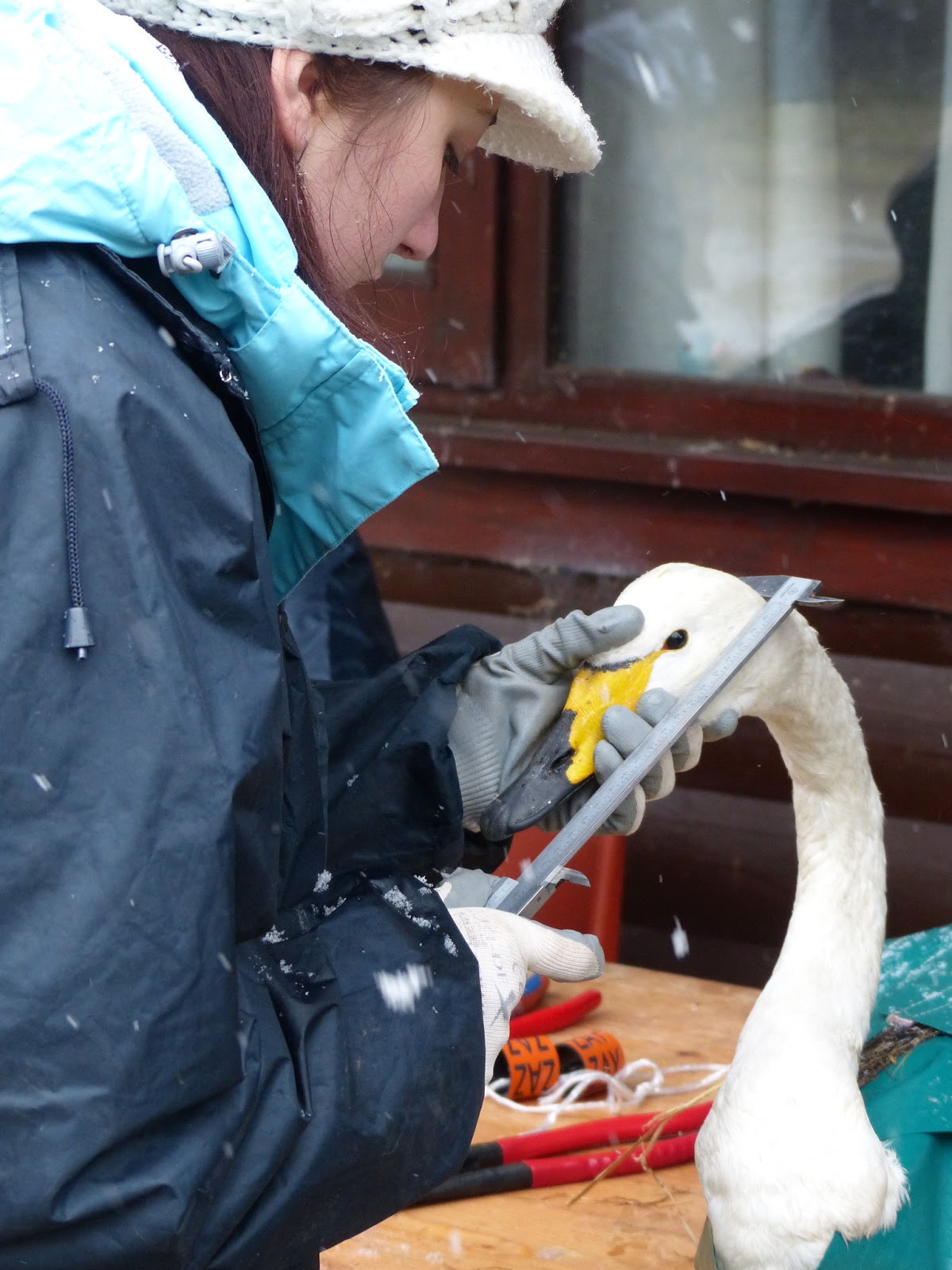
Catching so many swans also provides the opportunity to take samples from a number of birds to test for avian flu or other pathogens, and to take x-rays to look at the frequency of birds carrying lead from illegal hunting. This was the primary purpose of last weeks catch and so a sample of 73 birds was ideal (49 new, 24 re-traps). Out of the 24 re-traps 22 had originally been ringed at Martin Mere, and the other two were controls from Iceland and Welney WWT.
None of the birds which have been ringed/seen in the LDV NNR were caught this time, although over the years we have had 14 Whooper interchanges with Martin Mere, 11 with Caerlaverock and 10 with Welney. One intrepid explorer has even been to all three WWT centres along with the LDV, 'DZI' was ringed as an adult female in Iceland in 1992 and was last seen ten years later in Scotland. Full life history listed below:
02.08.92 - Ringed in Skijalflavatn, N.Iceland
15.10.92 - Sighted at Welney WWT
23.02.92 - Sighted at Welney WWT
17.10.93 - Sighted at Martin Mere WWT
06.11.93 - Sighted at Martin Mere WWT
12.11.92 - Sighted at Welney WWT
20.03.94 - Sighted at Welney WWT
06.03.95 - Sighted at Skitten, Caithness, Scotland
01.04.95 - Sighted at North Killiminster, Wick, Caithness, Scotland
01.11.95 - Sighted at Caerlaverock WWT, Dumfries
06.11.96 - Sighted at LDV NNR
02.01.97 - Sighted at Welney WWT
22.11.97 - Sighted at North Killiminster, Wick, Caithness, Scotland
10.02.02 - Sighted at Loch Eye, Easter Ross, Highland, Scotland
No Bewick Swans were caught on this catch, but in the past there have been three interchanges with Martin Mere, 3 with Slimbridge and a single movement with Caerlaverock.
The total catch from Martin Mere consisted of 190 birds: 51 Mallard, 26 Shelduck, 19 Pintail, 12 Pochard, 5 Teal, 3 Coot and a single Greylag. Over the past few years we've had 3 Shelduck to Martin Mere and 1 from there that was later caught in our cannon net catch last January. We've also had two of our Mallards go to Caerlaverock, plus two Barnacle Geese that were ringed there later appeared in the LDV. So over the years there's been lots of interchanges between the sites, and hopefully more to come, we may even catch up with some of these birds again! It was nice to get some more experience and handling of ducks that are rarely caught in the LDV such as Pochard - over the years we've only ringed four in the valley, but all have been from the British breeding population and one interesting recovery has been generated (details below).
LDV Pochard recovery - GF75766 (6 Female), ringed in the LDV on the 28.05.97, recovered on 10.11.02 in Dresden, Germany (shot), 1067 Km.
Below is a more typical recovery of a wintering bird which suggests that these wintering populations come from further east.
LDV Pochard recovery - D778538 (4 Female), ringed on Lake Engure, Latvia on 13.06.72, recovered on 05.12.75 in Melbourne, LDV NNR (shot), 1551 Km.
Health and safety is obviously vital when handling all these birds, hence the protective clothing and the chemical footbath and sprays - with such a number of birds involved we certainly don't want to end up spreading anything between the reserves.
Education is always an important part of conservation programmes, especially those run by the WWT at centres like Martin Mere and back in the valley with what we do at the NNR base at Bank Island. A school party visiting the centre on the day of the catch got to enjoy a very special experience of seeing the birds up close and personal - hopefully a real memory for them!
As we headed back across the Pennines (through quite a snow storm!) the WWT team headed up to Caerlaverock for a catch the next day - in which they processed 205 birds, including 119 Whoopers and 58 Mutes - nice work guys over the course of two days - especially with the weather! Many thanks again to Kane and his team at the WWT for asking us to help out and making us feel so welcome.
Saturday, 9 February 2013
08/02/13 - Going Dutch (well not quite)
First off, we were sent details of a darvic'd Mute Swan that has been seen on the Humber - its the first sighting of one of our birds caught during the first ever swan round-up last year in the LDV.
Red 597 (X6128) was ringed as a first year male at Bank Island last year on the 20th August (one of 18 caught that day - photos below), and was still present in the valley on the 12th September. We've been sent details of his whereabouts thanks to Russel Hayes, who came across 597 in New Holland, Lincolnshire, on the Humber Estuary on the 28th January 2013.
New Holland is a site where we have had a number of movements over the years concerning our ringed birds from the LDV, it is a small port where boats bring in grain and animal food, and it is thought that the swans (including a small number of wintering Whoopers) feed on the spilled grain. Most of the birds which have been seen here have either also been seen at (or subsequently) turn up at Hornsea Mere (usually in the summer for the moult) so it will be interesting to see if 597 also follows this route.
It's also interesting that this swan was from the first group of moulting birds ever to use the LDV - presumably staying due to the very wet conditions last summer. It provides an insight into this behaviour should this trend continue, and shows the turnover of birds in and around the LDV. Despite the valley holding up to 130 Mute Swans at the moment, some of our summer herd birds like this one have clearly moved out whilst others have settled locally, and presumably other birds from elsewhere have since arrived. Many thanks to Russ for the record and above photo.
Also last week - whilst at Castle Howard Andy Walker came across one of our colour-ringed Coots from last summer. It was ringed as an adult at Bank Island on 28th August 2012. This is the first sighting of it since ringing, and follows three Tufted Duck ducklings that were ringed at Wheldrake in August and also moved to Castle Howard last autumn. The 28th August was a good day indeed - not just for Coots (5 caught), we also caught a Shoveler and Moorhen on the scrape behind Bank Island, before earlier in the day spring trapping a Common Sandpiper and mist netting Snipe. We had several goes at hand catching ducks last August - with great success...
Catching these birds by hand involves walking the edges, in particular keeping a look out for Coots as they dive and hide amongst the weed - instead of coming all the way back up they have a habit of just pushing their beak through the weed to breath - it takes a beady old eye to see them... On spotting them the best thing to do is to try and get behind them if possible, then just lean down and pick them up - sounds far easier than it actually is.....
There's not much else to report from the valley this week - unsurprisingly the water levels are still high.... which has caused the ducks to disperse and North Duffield Carrs to be fairly quiet most days.
However, on Wednesday we did come across this rather nice find at Hagg Bridge - 5 Pink-footed Geese mixed in with a flock of 141 Greylags (photos below). Last month there was the usual large movement of Pinks north-west in early January as birds start to head north (from the Humber and North Norfolk coast) across to Lancashire before the final leg to Iceland later in the spring. Passage skeins will contine to follow over the next month or two, but usually only small groups like this stop on the deck for any length of time. Longer staying small groups and singles also become more of a significant feature in April and early May, and perhaps reflect less fit, unwell or 'pricked' (shot/wounded) individuals uncapable of making the long flight home again and fall short of their comrades.
It's always nice to come across a Pink or two, but lately the local birders have been after a similar species - the Tundra Bean Goose. Several frustrating attempts have been had to try and catch up with two birds that have been present in the valley recently but have appeared (or not in this case) difficult to find.
Then to top the day off we came across this beauty - a case of right place right time - two minutes later he disappeared inbetween the bales - must have been keeping warm in there and out of the 40mph gusty winds sweeping the valley!
There's been quite a few Barn Owls showing lately throughout the valley, particularly day flying on nice calm days. Bank Island, Thorganby viewing platform and North Duffield Carrs provide good opportunities to see them (occasionally with photographic opportunities), and along the Pocklington Canal and Melbourne are regular haunts.


.jpg)