Welcome to the LDV NNR ringing blog, this blog is designed to share the experiences, findings and tales from a group of dedicated ringers. We specialise in conservation orientated research projects, largely focusing on wildfowl, waders, owls and birds of conservation concern, in and around the Vale of York NNR's.

NB - Whilst the purpose of this blog was initially designed to cover our nationally important wildfowl ringing activities, it now also features wildlife and work posts, explaining how we manage the NNR for both wildlife and people.

For daily sightings please visit our Twitter account: https://twitter.com/ldv_nnr (@LDV_NNR)

For details of events, volunteer tasks and wildlife images please visit our Facebook account: https://www.facebook.com/Lower-Derwent-Valley-Skipwith-Common-NNR

Tuesday, 9 October 2012

08/10/12 - Reaping the rewards

Colour-rings...Whoopers...Tufties...colour-marked waterfowl...c/r Black-tailed Godwits, darvic'd Herons - the results (so far....)

Last week Russ (a regular LDV birder) spotted one of our colour-ringed Tufted Ducks at Castle Howard, this is the second Tufted Duck to be seen recently, giving us two movements from the 16 we ringed this summer - definitely worth all the getting wet and ploughing through weed covered ditches in chest waders. 

- Tufted Duck (FH51227) ringed as a 1 (duckling) on 7th August at Wheldrake Ings (10 days off fledging), re-sighted at Castle Howard on 1st September - a rapid movement.

- Tufted Duck (FH51210) - ringed as a 1 (brood of 3) on 4th August at Wheldrake Ings (just days off fledging), re-sighted at Castle Howard on 6th October - photographed below.


It's great to get some data from our birds as they move around, rather than just when they're shot - and we may yet get some multiple sightings of these birds, hopefully from other sites too. It's also good to know that the rings have been seen when the birds have been in the water and rolling when preening - here's hoping for some Shoveler and Gadwall sightings too - there are 23 Shoveler and 16 Gadwall out there with colour-rings, who's going to see the first one.....? If you do see any of our colour-ringed ducks then look for a single colour-ring on each leg, please note down which colours are on which leg to allow us to identify the bird as to where and when it was ringed. Keep checking those legs!


The first Whooper Swans have also been reported back in the valley, several were seen at North Duffield Carrs on Saturday (5th) and 11 were at Bank Island on Monday (8th). This year we've had data back on five Whooper Swans ringed in the LDV, 3 birds were seen in Ross-shire, Scotland during March - two from last years catch (G5A & G5C seen on 17/18th March) and one bird from the 2008 catch (K3K). We also had another two recoveries from Iceland and the first ever LDV Whooper to Norway (K3H). Unfortunately due to the flood water and grass not being cut this year, it's going to be difficult to read any darvics from the returning birds - and perhaps difficult to make a catch too.... But if you do see any of our ringed Whoopers then see if you can make out a ring - it should be on the left leg, and will be yellow with 3 numbers/letters in black writing.


Even though we can't actually get out there at the moment and catch any birds it is good to see some valuable data coming in and knowing that we made the most of the birds we have ringed over the summer. 

So a big thank you to the whole team for their efforts this summer!

Also, whilst we're on the topic of colour-ringing...we've finally managed to get data back on two of the colour-ringed Black-tailed Godwits present in the valley during March & April. One of them (the bird caught during the Whimbrel catch), was initially ringed in Suffolk in 2008 and has been seen many times since, whilst the other was first ringed in 2001 as an adult in Iceland and since then it's been seen in Spain, France, Ireland, the Netherlands & finally in England on the LDV NNR. Below are their full life histories.

Black-tailed Godwit - Orange/Lime/Orange, Lime/Orange/Black:

2008 - Ringed as a juvenile female on 27th October, on the Orwell Estuary, Suffolk
2008 - Sighted on the 21st November, in Orwell Country Park, Suffolk
2008 - Sighted on the 4th & 6th December, on the Stour Estuary, Essex
2009 - Sighted on the 28th March on Hazlewood Marshes NR, Alde Estuary, Suffolk
2009 - Sighted on the 8th July on Boyton RSPB reserve, River Ore, Suffolk
2009 - Sighted on the 24th October on the Thames Estuary, Kent
2010 - Sighted on the 6th April, on the Stour Estuary, Suffolk
2011 - Sighted on the 12th February on Trimley Marshes SWT reserve, Suffolk
2011 - Sighted on the 15th October on the Orwell Estuary, Suffolk
2012 - Caught on the 27th April in the LDV during the Whimbrel catch
2012 - Sighted again on the 28th & 29th April in the LDV

This bird has racked up quite a history in just five years, its journey has mainly involved the south, with it sighted on various sites within Suffolk, Essex and Kent. This is the first time it's made its way to Yorkshire though (well that we know of). It's really great being able to piece together a birds journey like this and to see how and where it has spent its life.

Black-tailed Godwit - 27/04/12

Black-tailed Godwit - Red/Yellow, Lime/Lime

2001 - Ringed as an adult on 28th April in SW Iceland
2002 - Sighted on 3rd May in SW Iceland
2003 - Sighted between 25th-29th April in SW Iceland
2004 - Sighted on 4th February in W France
2004 - Sighted on 21st & 23rd April in SW Iceland
2004 - Sighted on 18th July in SW Iceland
2005 - Sighted on 23rd June on the Isle of Sheppey, Kent, SE England
2006 - Sighted on 8th October on Fobbing Marsh, Essex, E England
2007 - Sighted on 18th January in Spain
2007 - Sighted between 25th-28th April in SW Iceland
2007 - Sighted on 7th & 10th September in S Spain
2008 - Sighted on 26th & 27th April in SW Iceland
2009 - Sighted on 3rd May on Belfast Harbour, N.Ireland
2010 - Sighted on 25th October in C.Ireland
2011 - Sighted on 24th March in Holland, W Netherlands
2012 - Sighted on 22nd March in the LDV

This bird has been seen every year since it was first caught 12 years ago!  

Also, (it's abit late coming out but we'll share it with you anyway) in May and June we had the first and second sightings of two of our darvic'd Grey Herons that were ringed this year. On 30th April we visited the local heronry on what turned out to be the only visit due to the shocking weather, and ringed 10 chicks (5 were big enough for darvics). On Wednesday 30th May the first one was sighted behind the office at Bank Island - two herons were seen flying in from the Thorganby direction, a young bird with an adult, the young bird had the yellow and black darvic '03'. Eight days later (7th June) '02' was seen flying in from Thorganby and landed at Bank Island. It's great to know that they survived the bad weather and a nice start to the history of our herons, hopefully there'll be lots more sightings to come.

What is also interesting is the fact that during August over 40 Herons, including many young, built up on Bank Island, and of these were none of our birds from the heronry....where had our birds gone and where had all these birds come from?? Sometimes not getting data is as interesting as getting data!

Friday, 5 October 2012

30/09/12 - Game over

Last week saw the first Jack Snipe for the autumn find its way into our nets - the first of many we had hoped...however the heavy rain that fell between the 24th - 26th put paid to that idea, with Bank Island now once again resembling a large lake, thus no Snipe - but out there (somewhere......) there's over 80 colour-ringed individuals.......


September summary.....the month got off to quite a slow start with only a handful of birds caught in the first week, but then the weekend of the 8th/9th saw a massive catch of Moorhens - 22 in just two days - the months total now stands at 41 (81 for the year). One of the Moorhens caught this month had the white feathers again that we have mentioned in a previous post, this is the third individual to be caught with this colour aberration.


The following week Jean released her Marsh Harrier on to North Duffield Carrs, which hopefully went on to join the other roosting birds. More Teal, 2 Little Grebes, a Tufted Duck and Pochard were then caught, plus several dawn catches resulted in another good number of Snipe ringed and colour-ringed. This brings us to 32 for the month and 84 for the year.

This time last year we were already up and running with the whoosh nets, however until the flood water starts to recede and the tracks become passable again it may be awhile until our next post...

Below are the totals for September and the year so far:

                                            September       Year
WATERFOWL


Grey Heron 0
10
Mute Swan 0
44
Greylag Goose 0
8
Brent Goose 0
1
Shelduck 0
78
Wigeon 0
117
Teal 32
324
Mallard 4
370
Pochard 1
1
Garganey 0
1
Shoveler 0
25
Tufted Duck 1
16
Pintail 0
5
Gadwall 0
26
Moorhen 41
81
Coot 0
46
Little Grebe 2
4


WADERS


Whimbrel 0
2
Snipe 32
84
Jack Snipe 1
2
Ruff 0
9
Redshank 0
2
Lapwing 1
7
Oystercatcher 0
2
Ringed Plover 0
4
Dunlin 1
3
Spotted Redshank 0
1
Greenshank 0
2
Green Sandpiper 1
6
Common Sandpiper 0
4


RAPTORS/OWLS


Marsh Harrier 1
1
Red Kite 0
1
Tawny Owl 1
17
Little Owl 0
2
Barn Owl 2
96
Kestrel 1
39
Sparrowhawk 1
1

Monday, 24 September 2012

22/09/12 - Jack...frost

Last night saw the first frost of the autumn, on the equinox in the Lower Derwent Valley NNR and the same night saw the first Jack Snipe of the autumn appear and find its way into our mist nets.

Large numbers pass through the Lower Derwent Valley/Skipwith Common NNR's each year, mainly in October and November with a smaller return passage in March and April. Last nights bird seemed a little early but on checking the records it is probably about on time. Small, but sometimes significant numbers can occur in late September, with 24 caught in five mist netting sessions at Bank Island between late September and early October in 2002, when as many as 50-60 birds may have been present. However, most birds do occur from mid October to late November depending on water levels and ground conditions, the 14 caught drag netting over a 6 day period in November 2010 being typical of this.


This is the second bird to be caught here this year, following one caught on Skipwith Common earlier in the year. Hopefully we'll be in for another bumper year to add to our total of 83 ringed in the valley as the conditions look perfect for them and there is currently large numbers of Snipe still coming through. We have in the past held public Jack Snipe events if birds are reliable (similar to the public Storm Petrel ringing sessions on the coast) and these have always proved popular, so we would be looking to hold these again if it's a good autumn - more details to come later.

As well as the Jack Snipe, another 2 Common Snipe were caught and ringed along with 2 Teal.

Sunday, 23 September 2012

13/09/12 - NNR team visit

On Wednesday the NNR Estates and Procurement Team visited the LDV for a look round Bank Island and to help with a few tasks - whilst here we also put on a ringing demo to give them the opportunity to see a few birds up close, and find out exactly why we ring and what it involves.

Unfortunately soon after their arrival the heavens opened and the rain lashed down, this soon brought the ringing to a halt but we did manage to catch a few birds beforehand! Nets had been opened in the hope of a few Snipe, however the Snipe had other ideas and were nowhere to be seen! Instead we came away with a handful of hirundines - Swallows, Sand Martins & House Martins. There were massive numbers present in the valley on Wednesday, leading us to believe that there was some movement going on.


After the ringing demo everyone (well most of them!) donned the waterproofs and got stuck in, helping us with a variety of tasks, from making nest boxes for Barn Owls and Kestrels to weeding and planting up the Base Garden.


In just the short time that they were here they helped make several nest boxes which will soon be put up around the valley and hopefully next year they will be used by a breeding Barn Owl or Kestrel pair. 

Despite the wet conditions everyone enjoyed themselves and a good time was had (we think!).

Not much else to report from the last week or so....between the 17th and 21st nine Moorhens have been caught, with one or two a day - much slower than it has been in recent weeks. 

Teal numbers continue to build (upto 500 now) with small groups of Wigeon, the odd Pintail and skeins of Pink-footed Geese moving south - winter wildfowl ringing is not far away!

Wednesday, 19 September 2012

11/09/12 - Marshy heads back into the wild

Last week Jean received a phonecall telling her of an adult female Marsh Harrier which had been seen in a farmers field, seemingly unable to take off fully from the ground. Jean soon had the bird in her care, and whilst checking her over noticed feather damage in lines on both wings, suspected to have been caused by hitting wires. Whilst not causing any major damage, it had clearly left her bruised and unable to hunt well, and as a result of this she was massively under weight for a bird her age, sex and size, and therefore unable to hunt further. Due to this she was on a downward spiral without help. On arrival Jean weighed her at 400 grams - massively under the actual average weight for an adult female Marsh Harrier - over 700 grams.

Marsh Harrier on arrival at Jean's

Jean soon fed her up on chicks and a week later she weighed 680 grams and was raring to go. Large birds of prey like Marsh Harriers usually make it obvious when they are ready to go and it's a case of going with that before they either damage or stress themselves in care. It was decided that she would be released onto North Duffield Carrs where there is currently a Marsh Harrier roost of atleast 12 birds - more details can be found here on Andy's blog, a regular LDV birder. 

Marked wings from the wires

Ready to go...

Off at speed!

Another great job Jean, well done! This is the second Marsh Harrier that Jean has helped make its way back into the wild. The previous being in 2008 which had also hit wires and was unable to fly and feed.

Over the weekend Snipe numbers seemed to be on the increase and so another session was had in the early hours of Monday (10th) - another 4am start! The first round was quite unbelievable really, with 2 Little Grebes caught! Plus 5 Snipe and 2 Teal. A few rounds later and we were upto 15 Snipe for the morning, with many caught in full light. The duck trap also held three new Moorhen.

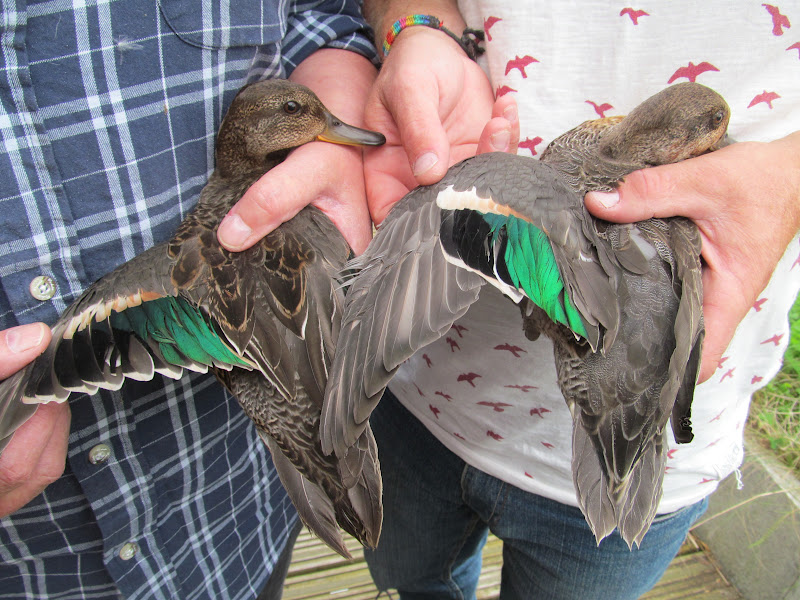
Photos (top to bottom) - Little Grebe (this years), Juvenile male and adult male Teal, Adult male Teal showing chestnut brown feathers coming through, Common Snipe - 15th for the day.