Pages
- Home
- June 26
- May 26
- Apr' 26
- Mar' 26
- Feb' 26
- Jan' 26
- Dec' 25
- Nov' 25
- Oct' 25
- Sept' 25
- Aug' 25
- July 25
- June 25
- May 25
- Apr' 25
- Mar' 25
- Feb' 25
- Jan' 25
- Dec' 24
- Nov' 24
- Oct' 24
- Sep' 24
- Aug' 24
- July 24
- June 24
- May 24
- Apr' 24
- Mar' 24
- Feb' 24
- Jan' 24
- Dec' 23
- Nov' 23
- Oct' 23
- Sep' 23
- Aug' 23
- July 23
- June 23
- May 23
- Apr' 23
- Mar' 23
- Feb' 23
- Jan' 23
- Dec' 22
- Nov' 22
- Oct' 22
- Sept' 22
- Aug' 22
- Jul' 22
- Jun' 22
- May 22
- Apr' 22
- Mar' 22
- Feb' 22
- Jan' 22
- Dec' 21
- Nov' 21
- Oct' 21
- Sep' 21
- Aug' 21
- Jun' 21
- Jul' 21
- Mar' 21
- May 21
- Apr' 21
- Nov' 20
- Feb' 21
- Jan' 21
- Dec' 20
Welcome to the LDV NNR ringing blog, this blog is designed to share the experiences, findings and tales from a group of dedicated ringers. We specialise in conservation orientated research projects, largely focusing on wildfowl, waders, owls and birds of conservation concern, in and around the Vale of York NNR's.
NB - Whilst the purpose of this blog was initially designed to cover our nationally important wildfowl ringing activities, it now also features wildlife and work posts, explaining how we manage the NNR for both wildlife and people.
For daily sightings please visit our Twitter account: https://twitter.com/ldv_nnr (@LDV_NNR)
For details of events, volunteer tasks and wildlife images please visit our Facebook account: https://www.facebook.com/Lower-Derwent-Valley-Skipwith-Common-NNR
Wednesday, 20 February 2013
16/02/13 - 395 birds, 400+ miles = job done!
Most of the waterfowl ringing in the UK is either undertaken at the WWT centres across the country, through WWT sponsored projects or on a handful of other sites supported by the WWT. At the WWT centres like Slimbridge, Martin Mere, Welney and Caerlaverock, most of the birds are caught during an annual catch using the swan pipes, which are mainly aimed at securing a sample of Whooper or Bewick Swans. The birds are fed here twice daily with large amounts of grain, and in the hope of getting the birds used to entering the mouth of the swan pipe. Feeding the swans is also a great opportunity for reading darvics, from a short stint in one of the hides we managed to spot 21 darvic'd birds, plus two with metal rings.
These type of catches can vary but typically they contribute to the majority of certain waterfowl species ringed each year in the UK. The number of Whooper Swans ringed in the UK varies between 125-200, whilst ringing totals for Pochard and Pintail both vary between 20-200 birds per year, largely dependent on the success of these annual catches, which can typically take between 100-200 birds a catch. During the catch the birds are fed in the entrance of the swan pipe, then once there is a suitable (and safely manageable) number present, the door is dropped and the team rush in to herd the catch up the narrowing pipe and into the collecting pens (plus hand netting the odd duck on route). This contrasts to the 1100 waterfowl a year that can be ringed in the LDV during a good year, although we usually do it in small catches of upto 20-30 birds max. Some species such as Teal and Wigeon are seldom caught in swan pipe catches, and so further make the numbers caught in the LDV more noteworthy.
Whooper Swans have been fitted with darvics in the UK and Iceland since the late 1980's in order to find out more about their movements, ecology and welfare. Marking a sample in the population to continue this work is still important to our understanding and conservation of these birds.
Catching so many swans also provides the opportunity to take samples from a number of birds to test for avian flu or other pathogens, and to take x-rays to look at the frequency of birds carrying lead from illegal hunting. This was the primary purpose of last weeks catch and so a sample of 73 birds was ideal (49 new, 24 re-traps). Out of the 24 re-traps 22 had originally been ringed at Martin Mere, and the other two were controls from Iceland and Welney WWT.
None of the birds which have been ringed/seen in the LDV NNR were caught this time, although over the years we have had 14 Whooper interchanges with Martin Mere, 11 with Caerlaverock and 10 with Welney. One intrepid explorer has even been to all three WWT centres along with the LDV, 'DZI' was ringed as an adult female in Iceland in 1992 and was last seen ten years later in Scotland. Full life history listed below:
02.08.92 - Ringed in Skijalflavatn, N.Iceland
15.10.92 - Sighted at Welney WWT
23.02.92 - Sighted at Welney WWT
17.10.93 - Sighted at Martin Mere WWT
06.11.93 - Sighted at Martin Mere WWT
12.11.92 - Sighted at Welney WWT
20.03.94 - Sighted at Welney WWT
06.03.95 - Sighted at Skitten, Caithness, Scotland
01.04.95 - Sighted at North Killiminster, Wick, Caithness, Scotland
01.11.95 - Sighted at Caerlaverock WWT, Dumfries
06.11.96 - Sighted at LDV NNR
02.01.97 - Sighted at Welney WWT
22.11.97 - Sighted at North Killiminster, Wick, Caithness, Scotland
10.02.02 - Sighted at Loch Eye, Easter Ross, Highland, Scotland
No Bewick Swans were caught on this catch, but in the past there have been three interchanges with Martin Mere, 3 with Slimbridge and a single movement with Caerlaverock.
The total catch from Martin Mere consisted of 190 birds: 51 Mallard, 26 Shelduck, 19 Pintail, 12 Pochard, 5 Teal, 3 Coot and a single Greylag. Over the past few years we've had 3 Shelduck to Martin Mere and 1 from there that was later caught in our cannon net catch last January. We've also had two of our Mallards go to Caerlaverock, plus two Barnacle Geese that were ringed there later appeared in the LDV. So over the years there's been lots of interchanges between the sites, and hopefully more to come, we may even catch up with some of these birds again! It was nice to get some more experience and handling of ducks that are rarely caught in the LDV such as Pochard - over the years we've only ringed four in the valley, but all have been from the British breeding population and one interesting recovery has been generated (details below).
LDV Pochard recovery - GF75766 (6 Female), ringed in the LDV on the 28.05.97, recovered on 10.11.02 in Dresden, Germany (shot), 1067 Km.
Below is a more typical recovery of a wintering bird which suggests that these wintering populations come from further east.
LDV Pochard recovery - D778538 (4 Female), ringed on Lake Engure, Latvia on 13.06.72, recovered on 05.12.75 in Melbourne, LDV NNR (shot), 1551 Km.
Health and safety is obviously vital when handling all these birds, hence the protective clothing and the chemical footbath and sprays - with such a number of birds involved we certainly don't want to end up spreading anything between the reserves.
Education is always an important part of conservation programmes, especially those run by the WWT at centres like Martin Mere and back in the valley with what we do at the NNR base at Bank Island. A school party visiting the centre on the day of the catch got to enjoy a very special experience of seeing the birds up close and personal - hopefully a real memory for them!
As we headed back across the Pennines (through quite a snow storm!) the WWT team headed up to Caerlaverock for a catch the next day - in which they processed 205 birds, including 119 Whoopers and 58 Mutes - nice work guys over the course of two days - especially with the weather! Many thanks again to Kane and his team at the WWT for asking us to help out and making us feel so welcome.
Saturday, 9 February 2013
08/02/13 - Going Dutch (well not quite)
First off, we were sent details of a darvic'd Mute Swan that has been seen on the Humber - its the first sighting of one of our birds caught during the first ever swan round-up last year in the LDV.
Red 597 (X6128) was ringed as a first year male at Bank Island last year on the 20th August (one of 18 caught that day - photos below), and was still present in the valley on the 12th September. We've been sent details of his whereabouts thanks to Russel Hayes, who came across 597 in New Holland, Lincolnshire, on the Humber Estuary on the 28th January 2013.
New Holland is a site where we have had a number of movements over the years concerning our ringed birds from the LDV, it is a small port where boats bring in grain and animal food, and it is thought that the swans (including a small number of wintering Whoopers) feed on the spilled grain. Most of the birds which have been seen here have either also been seen at (or subsequently) turn up at Hornsea Mere (usually in the summer for the moult) so it will be interesting to see if 597 also follows this route.
It's also interesting that this swan was from the first group of moulting birds ever to use the LDV - presumably staying due to the very wet conditions last summer. It provides an insight into this behaviour should this trend continue, and shows the turnover of birds in and around the LDV. Despite the valley holding up to 130 Mute Swans at the moment, some of our summer herd birds like this one have clearly moved out whilst others have settled locally, and presumably other birds from elsewhere have since arrived. Many thanks to Russ for the record and above photo.
Also last week - whilst at Castle Howard Andy Walker came across one of our colour-ringed Coots from last summer. It was ringed as an adult at Bank Island on 28th August 2012. This is the first sighting of it since ringing, and follows three Tufted Duck ducklings that were ringed at Wheldrake in August and also moved to Castle Howard last autumn. The 28th August was a good day indeed - not just for Coots (5 caught), we also caught a Shoveler and Moorhen on the scrape behind Bank Island, before earlier in the day spring trapping a Common Sandpiper and mist netting Snipe. We had several goes at hand catching ducks last August - with great success...
Catching these birds by hand involves walking the edges, in particular keeping a look out for Coots as they dive and hide amongst the weed - instead of coming all the way back up they have a habit of just pushing their beak through the weed to breath - it takes a beady old eye to see them... On spotting them the best thing to do is to try and get behind them if possible, then just lean down and pick them up - sounds far easier than it actually is.....
There's not much else to report from the valley this week - unsurprisingly the water levels are still high.... which has caused the ducks to disperse and North Duffield Carrs to be fairly quiet most days.
However, on Wednesday we did come across this rather nice find at Hagg Bridge - 5 Pink-footed Geese mixed in with a flock of 141 Greylags (photos below). Last month there was the usual large movement of Pinks north-west in early January as birds start to head north (from the Humber and North Norfolk coast) across to Lancashire before the final leg to Iceland later in the spring. Passage skeins will contine to follow over the next month or two, but usually only small groups like this stop on the deck for any length of time. Longer staying small groups and singles also become more of a significant feature in April and early May, and perhaps reflect less fit, unwell or 'pricked' (shot/wounded) individuals uncapable of making the long flight home again and fall short of their comrades.
It's always nice to come across a Pink or two, but lately the local birders have been after a similar species - the Tundra Bean Goose. Several frustrating attempts have been had to try and catch up with two birds that have been present in the valley recently but have appeared (or not in this case) difficult to find.
Then to top the day off we came across this beauty - a case of right place right time - two minutes later he disappeared inbetween the bales - must have been keeping warm in there and out of the 40mph gusty winds sweeping the valley!
There's been quite a few Barn Owls showing lately throughout the valley, particularly day flying on nice calm days. Bank Island, Thorganby viewing platform and North Duffield Carrs provide good opportunities to see them (occasionally with photographic opportunities), and along the Pocklington Canal and Melbourne are regular haunts.
Monday, 4 February 2013
02/02/13 - Breaking the duck
However perhaps the most significant records concerned the positive numbers of farmland birds throughout the area, and the occurrence of a cold weather movement of Skylarks associated with snowfall with up to 2000 birds involved from the 20th, with smaller numbers of Corn Buntings. Overall throughout January a total of 96 bird species were recorded throughout the valley - many thanks to everyone who has contributed.
In contrast to last January & February which was largely all about our successful wildfowl catching, this January (and this winter) has indeed been very poor to say the least. It's been a fair while since we last blogged about ringing...simply because there hasn't been anything to share with you all! Never before have we had such a quiet spell, with some members of our team left wondering what to do on a weekend now! We seem to have been up against the extensive flooding for months now, which was followed by the big freeze, and along with being busy with other work it has resulted in few opportunities.
Local ringer Chris Wright managed to catch 14 of the 24 Waxwings that had been around his garden near Thorganby for a couple of days over the 6-7th, taking the total number of Waxwings ringed around the valley to 37. Photo below from November, when we successfully caught a number of these spectacular visitors.
We followed this by catching another Tawny Owl from a regular roost site at Thornton Ellers on 10th January, yet another new bird from this site - an adult male - maybe the mate of the female we caught there in November. It will be interesting to see just how many different birds use a single roosting site such as this.
Then on the weekend of 26-27th, the water had finally been showing signs of falling, and with duck withdrawal the guys could take it no longer, off to Duffield they headed, to locate the duck trap and see how many birds were present and if they were catchable. They set off armed with various tools and equipment to repair the trap and get it operational again if possible, however on arrival they were pleasantly surprised to find it firstly - looking in pretty good shape, and secondly - with birds in, despite there being no food in there for months! The trap had been left un-set and so the door and funnels were fastened open allowing birds to move in and out as they pleased. A quick dash through the snow saw all eight birds caught - 7 new Mallards and one re-trap (a bird initially ringed in the trap in March 2012). Maybe it was this bird that had a memory of finding food in the trap in the harsh weather, that had led the others in under false hopes! Either way we were finally off the mark with the first ducks of 2013 ringed. A few repairs and moderations were needed and the trap was ready to be set for the next day, however....success was to be short lived! On return on Sunday morning (27th), the 10cm of snow that had fallen had very quickly started to melt and with two inches of rain it meant that the trap had to be left open for the predicted flooding. Just a single new Mallard was in the trap making that eight for the year (who knows when the next will come!).
Our recent WeBS counts have shown that despite there being very few Mallards present on the 9th & 10th January, over 4000 were present on the 24th - a significant national count for this declining winter visitor. Thus ringing birds such as Mallards which may be considered 'common', could yet reveal valuable data.
Friday, 1 February 2013
28/01/13 - It's all snow'ver
We expected to come across prints from animals such as deer, hares, rabbits, squirrels and even the smaller mammals such as weasels and stoats, however we were after one inparticular - the otter. Otters are very elusive animals, and so alternative techniques of surveying them are required, such as checking for tracks and spraints. We were successful in our finds and came across several spraints on stones under bridges, and prints in the snow at North Duffield, Wheldrake and Ellerton. Below are a few photographs we took whilst out searching for signs of these elusive creatures, can you tell which animal/bird made them??
Otters have a long history in the Lower Derwent Valley, and a small population remained here when the national population reached its low ebb in the 1980's. In the early 1990's English Nature and the Vincent Wildlife Trust had a reinforcement project in the valley when several rehabilitated animals were soft released at both Wheldrake Ings and Thornton Ellers, as part of a wider River Derwent project. Since then the otter population has gone from strength to strength in the valley with an estimated three or four breeding females in the catchment now. Clearly a success in its own right, and the positive results have been more wide ranging, in that since the otter population has increased, the local mink population has dramatically decreased over the same period. Otters tend to push mink out of their territories and are believed to kill them if the opportunity arises. As a result of the declining population of mink, the area has also seen an increase in the number of water voles and species like Moorhen and Coot which breed on ditch sides and river banks.
Over the course of the month there has been a few records for otters - on the 15th a lucky visitor to the Geoff Smith Hide at North Duffield Carrs watched a single animal swimming in the River Derwent. Fresh spraints were found by the bailey bridge at Wheldrake Ings on the 22nd, with tracks also found in the snow near the windpump. More tracks of a female and two cubs were found at Bank Island on the 23rd. Many tracks were found in the snow along the floodbank at North Duffield Carrs and Ellerton on the 24th, a single otter was also caught on the camera at Wheldrake bridge. One or two injured orphaned cubs have also been rehabilitated and released back into the Derwent catchment over the last few years due to Jean Thorpe's excellent and dedicated hard work.
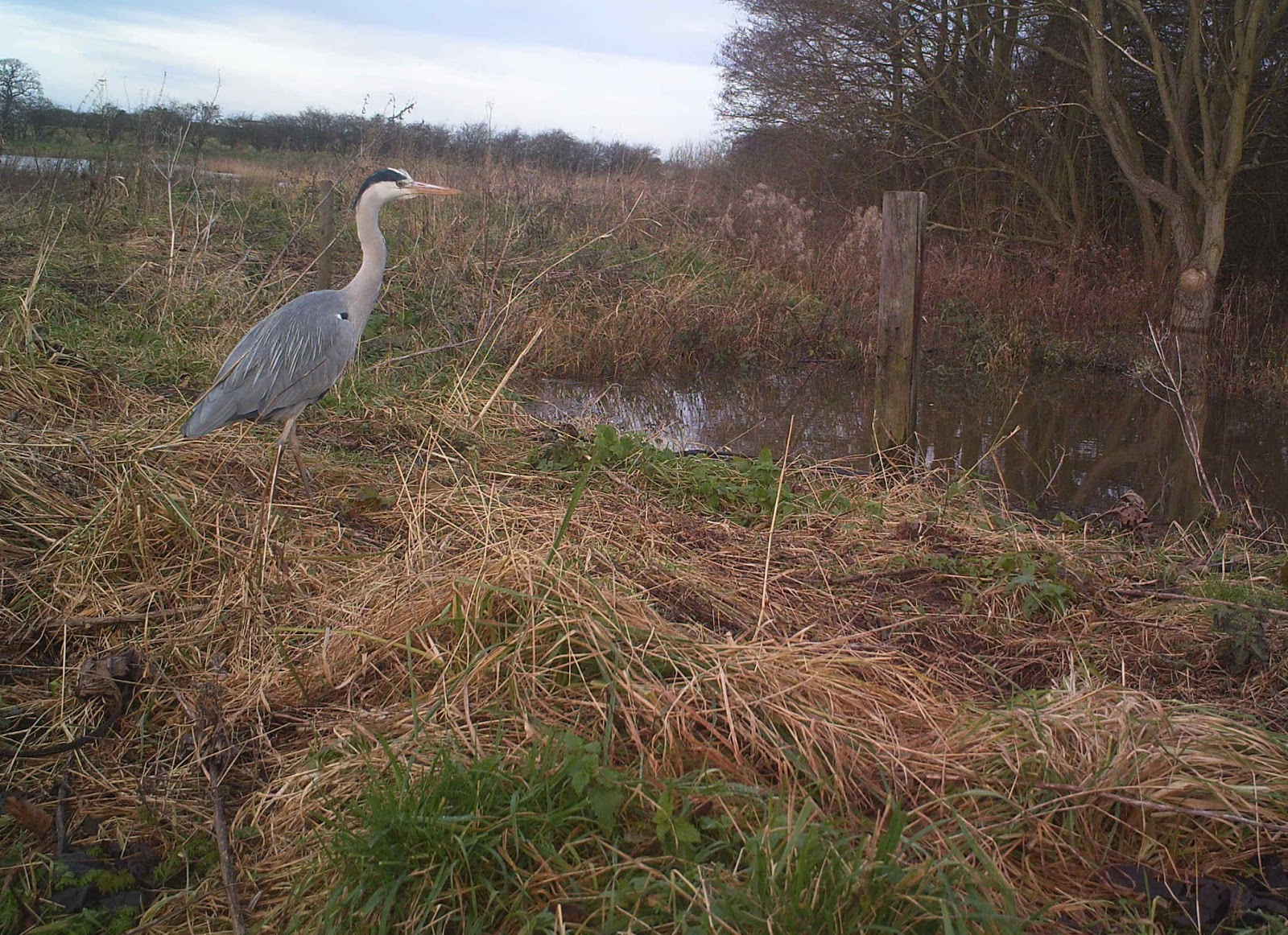
It's not just otters that have appeared on our cameras.....we've had a variety of wildlife caught in the act including a number of bird species - the most exciting being the exquisite Jay, followed by Robins, Redwings, Blackbirds, Red-legged Partridges, Crows, a Heron & ofcourse numerous inquisitive Pheasants! We've racked up a list of mammals too - numerous Badgers (a family from the nearby set), several Foxes, a family of Roe Deer, a female Otter with two cubs, a Brown Hare, Rabbit, Squirrels, Wood Mouse and a Stoat! Below are a sample from the 3000+ photos that were taken!