Welcome to the LDV NNR ringing blog, this blog is designed to share the experiences, findings and tales from a group of dedicated ringers. We specialise in conservation orientated research projects, largely focusing on wildfowl, waders, owls and birds of conservation concern, in and around the Vale of York NNR's.

NB - Whilst the purpose of this blog was initially designed to cover our nationally important wildfowl ringing activities, it now also features wildlife and work posts, explaining how we manage the NNR for both wildlife and people.

For daily sightings please visit our Twitter account: https://twitter.com/ldv_nnr (@LDV_NNR)

For details of events, volunteer tasks and wildlife images please visit our Facebook account: https://www.facebook.com/Lower-Derwent-Valley-Skipwith-Common-NNR

Thursday, 16 August 2012

08/08/12 - Swanning around

After the severe flooding in the valley this summer several broods of Mute Swans had failed attempts early on in the season but we were pleased to see that two pairs at North Duffield had managed to raise 8 cygnets between them (one brood of 5 & one of 3).

The pair at North Duffield Carrs were initially ringed back in 2001, this year they produced 5 cygnets which we've been keeping a close eye on. With them now being at a good size for ringing we decided to have a go for them today and so out came the canoes! James quickly volunteered for a go - think he fancied another dip in the water too! As soon as we entered the water the cygnets swam into the reeds but soon after all five were lined up on the bank ready to ring - with the adult male for company!


After such a successful attempt we decided to try for the other two pairs on the ditches. One pair were both un-ringed non breeders, these were both caught and went away with red darvics.


It was all going so well and we were feeling lucky at this point so we moved on to the next pair with 3 cygnets, James canoed down the ditch and each cygnet was lifted out as they swam down infront of him - it all went like a dream (this year)!

 
A Greylag was also added to the monthly totals today, due to the flooding no young geese were caught in May/June and so this was only the 8th one to be caught and ringed this year - 3 were whoosh netted in March, and the other 4 were caught in the corale in June & July. Numbers of Greylags ringed in the LDV tends to depend on the catches of post breeding flightless adults and young - this can account for upto 60+ birds most years. This year the geese did manage to breed before the main flood hit, but the young were only of a suitable ringing size during the peak water levels, hence no post breeding catch.


Friday, 10 August 2012

07/08/12 - Big effort = big rewards

After last weeks’ successful catches we were hoping for more of the same this week...& we weren’t disappointed! From the two sessions detailed below we've not only equalled but also passed the number of key species (especially ducklings) ringed last year in the valley and the UK! In the first 7 days of August we have managed to catch and ring 16 Gadwall (15 pulli), 9 Shoveler (8 pulli), 14 Tufted Duck (all pulli), 7 Moorhen (6 pulli), 18 Coot (16 pulli) and 6 Mallard (5 pulli). Fantastic effort by the LDV Team!

Over the weekend several of the team members kept the ringing going and managed another 8 Coot, 4 Tufted Ducks and 2 Moorhen (majority pulli). Monday was another baking hot day in the valley so it was hard work pushing the corale - but we came away with a young Coot and Moorhen for our efforts. It was the duck trap that really came up trumps today with a massive catch of Gadwall - in fact our biggest ever single catch! 8 ducklings and the adult female! The ducklings were a really good size for ringing and all were fitted with colour rings - including the adult. 


Also in the trap were 4 young Coot, all big enough to be ringed and colour-ringed, it’s unusual for us to ring this many Coot chicks in a season, usually the average is just a handful. Coot ringing in the valley is variable, and like most things is dependent on water levels. Large numbers can be whoosh netted in March and April if suitable conditions occur (upto 150) otherwise numbers can be quite low. The number of young Coot ringed each year depends on how suitable the conditions are during the breeding season and where post breeding birds happen to be. So for us to catch 16 young Coot in just a few days has been great, and with the national average for pulli Coot over for the last few years being 17 we're effectively doubling the number ringed in the UK.


Later on a visit to the Top Pond at North Duffield to remove the Common Ragwort provided the opportunity to see if there were any ducklings present, several walks through the reeds produced two ducklings - a Tufted Duck & Gadwall.


After a hard slog yesterday Ragwort’ing and duck catching surprisingly everyone was up for more of the same today! Though for those of you who think it's all about having fun it was decided that duck catching is definitely more tiring than Ragwort’ing!

A quick check of the duck trap first off resulted in a single Moorhen, a push of the corale followed which produced a young Coot and another Moorhen. All three birds were a good size and all went off with colour-rings. 


After spotting several broods of Tufted Ducks and Mallards in one of the ditches, a carefully positioned net soon caught a large Mallard duckling.


A long walk through the ditch and all the weed resulted in two Mute Swans, a brood of Tufted Ducks, Mallards and a single Wigeon heading towards the net! We were most pleased to come away with two Tufted Duck ducklings! The lads got very wet for their efforts - but were definitely delighted at the end result. 


Another visit to Duffield produced two Mallard ducklings amongst the long grass - they were quick but not quick enough! A young Gadwall duckling soon followed - very good birds to catch at the same time which allowed us to highlight the differences for the guys to see between both species. 


So all in all another very wet day - although with the ridiculously warm temperatures a cool dip in the ditch was quite welcome! Big thanks go to the lads - Adam, James & Sam for really getting stuck in and becoming part of the LDV team. It's great to have young and enthusiastic people who are keen to learn and really muck in whatever the conditions, and it's nice for us to share what we do especially when it's really appreciated by these three cracking lads!

Monday, 6 August 2012

03/08/12 - Ducking delight

Regular followers of our blog will be aware of the problems that have been caused by this summers persistent flooding on the Ings and on its breeding bird communities. It's been a complete wash out for all of the breeding waders and we'd thought that the ducks had suffered too... However! It turns out that they have been enjoying the conditions and managed to breed rather well, and have just remained hidden amongst the very dense flooded vegetation.

Recent survey work throughout parts of the valley have found (amongst others), over 140 Tufted Duck ducklings, 110 Shoveler ducklings, 170 Gadwall ducklings, 40 young Coot and 4 young Garganey still unfledged. This represents one of the best breeding seasons we've had in recent years. It also offers a really good chance to catch a few more of these seldom ringed species (particularly our own British bred ducklings) to try and gain a better understanding of their movements and conservation requirements. 

The first catching attempt was very hard work, pushing the ditches and corale in the baking hot sunshine and deep water with lots of weed just waiting to trip us up - there may have been some rather wet bodies too (and we don't just mean the ducks!). For our efforts we came away with two rather large Shoveler ducklings, a young Tufted Duck & a Moorhen.

A superb Shoveler!

Adding the colour-rings

This type of ringing isn't easy stuff and generally involves lots of hard work and effort for a few birds at a time - and definitely involves getting very wet and muddy - usually filling up chest waders and getting bitten by just about every species of insect which has mouth parts that bite! The rewards are very good though!

This....

 followed by this,

which ended in this...

...helped produce this!

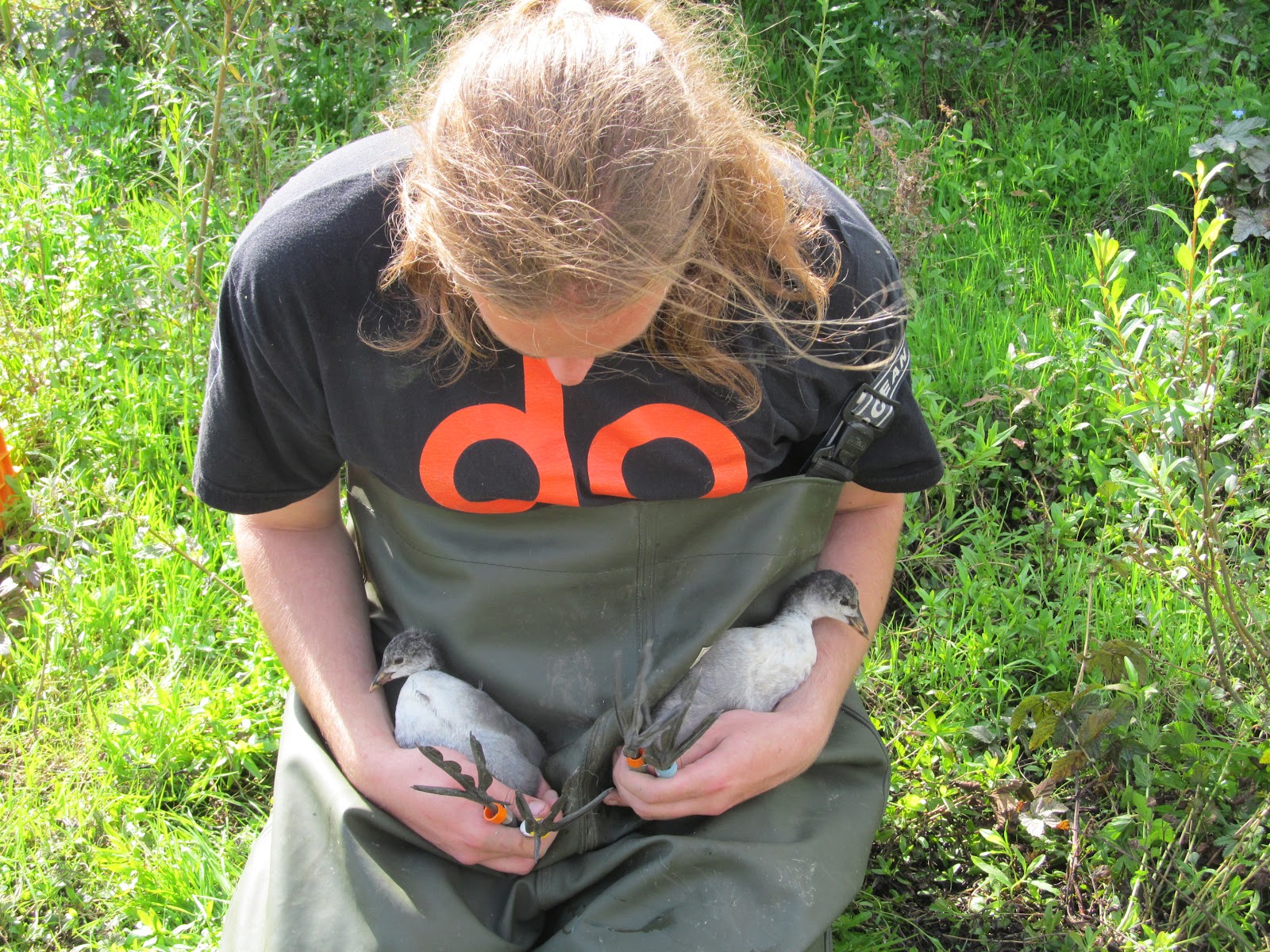
With the help of our two new volunteers, Adam & James (and potential new ringers), we followed on from the first session above (after we'd all dried off) and had another go, resulting in a MEGA catch! This consisted of: 4 Tufted Duck ducklings, a brood of three Shoveler ducklings (old enough to be sexed on the wing panel) plus the adult female, 5 Gadwall ducklings & 2 adult Coot plus 3 young. All of the birds from these two sessions were colour-ringed bar the 5 Gadwall ducklings as they were just abit too small to take the plastic rings.

Female & male Shoveler ducklings

Adult Coot & its young

Gadwall duckling

A handful of Gadwall ducklings!

One of 4 more Tufted Duck ducklings

The hard work and effort that went into catching all of the above and the potential data that we hope to get back from ringing these ducklings is worth the bites, cuts, blisters & wet feet!

Wednesday, 1 August 2012

01/08/12 - Bronze, Silver, & Gold!

Over the last few days the flood has finally receded, the water has started to come off the meadows and back into the ditches. In doing so it's brought all the waterfowl out of the emerged grassland and back onto the permanent water bodies and ditches, many in full moult and quite a few broods of unfledged ducklings that we didn't know were there.

It's also meant that our 'corale' trap has come into its own. This is basically a small fenced funnel amongst the bushes surrounding a permanent pool used by breeding birds. The birds are simply herded towards the funnel and moulting adults and unfledged young can be caught in a small catching area at the end - not unlike a heligoland trap.

Over the last four days we've caught 20 young Mallard, 2 Gadwall, 4 Teal, 4 Moorhen & a Coot in this way, as well as a few moulting adults. However late on Monday night we hit the jackpot and in terms of duck catching we got the gold in the form of a drake Garganey! Only two birds were present in the corale catching area on getting to it - a large Teal duckling (a close silver!) and the moulting drake Garganey! During the afternoon two Gadwall ducklings were also caught - definitely making it a bronze, silver & gold day - saving the best till the last!

Gadwall duckling

Drake Garganey - in eclipse

Moulting wing


Teal duckling (left), Garganey (right)

Catching these three species is really pleasing, Garganey are one of the key species in the Lower Derwent Valley NNR with usually atleast 3-4 pairs but numbers can be upto 10-15 pairs some years. The rather 'wet' conditions this year have proved attractive for this little migratory duck with upto 9 drakes and 5 females present during the breeding season. However sightings have been few and far between lately but catching this one just goes to show they can be hard to see, especially when moulting amongst the longer vegetation. 

This is the 16th Garganey to be ringed in the LDV NNR but only the second adult - the rest have been all ducklings. This site has now contributed to 3% of the 483 Garganey ever ringed in the UK (reflecting the sites importance for them) and 40% of all those ringed in the UK since 1990 when waterfowl first started on the site. The last two Garganey to be ringed in valley (and the UK) were two ducklings in 2007. One of these ducklings produced a southerly rapid post breeding dispersal (see below). Equally, British bred Teal are rarely caught and ringed in the UK, and it's always nice to add to our knowledge of them. In contrast to the other ducklings we ring on site which tend to head south, Teal post breeding dispersal tends to be to the northwest.

LDV Recoveries: Garganey (Anas querquedula)

EK82959, ringed as a 1 (duckling) on the 22.07.97 in the LDV NNR, recovered on 04.08.97 in Boulogne-sur-mer, Pas-de-calais, France (shot), distance travelled - 391Km. 

This is an excellent recovery of a British bred duckling, about which little is known. A rapid movement southwards towards its wintering grounds was unfortunately ended by illegal hunting in France. 

Hopefully through the new colour-ringing project with the WWT many sightings will follow, helping us learn more about our British bred ducklings and where they go.

Below are the totals for July along with the year so far:
                              
                                         July               Year
 
Grey Heron 0
10
Mute Swan 3
5
Greylag Goose 1
7
Brent Goose 0
1
Shelduck 0
78
Wigeon 3
117
Teal 9
290
Mallard 43
322
Garganey 1
1
Shoveler 1
1
Pintail 0
5
Gadwall 5
9
Moorhen 8
19
Coot 1
5
Little Grebe 0
1

75
871

Thursday, 19 July 2012

12/07/12 - A familiar face returns

In 1999 a fresh faced University student (Nick Askew) joined the LDV Team as a volunteer and spent the summer helping out with various farmland bird work around the NNR and then went on to start the LDV Barn Owl project. The fieldwork carried out during the summer of ’99 saw numbers of breeding Barn Owls go up from 20 pairs of which we knew of to a total of 69 pairs within the study area - Nick was soon hooked!

 One of the many boxes Nick put up in the valley

A BSc final year project report on Barn Owls along with a specific ‘C’ permit followed, plus a Phd on the species, which largely focused on the feeding ecology and how to better target agri-environment schemes and conservation measures for the species and how to better estimate population size and carrying capacity across the country. As well as monitoring the 100 or so nest sites or potential sites each year for his project, Nick also filled in nest record cards for BOMP (Barn Owl Monitoring Programme), and he probably ringed in the region of 500 Barn Owls in the area during his studies and beyond, he was also instrumental in the radio-tracking of 30 individuals. The recent publication of the ‘Barn Owl Conservation Handbook’ published by the Barn Owl Trust, contains some of the information published by Nick and his work in the LDV - it really is great to see that the study and Nick’s efforts have put something back into wider conservation.

Barn Owl c/ringed & radio-tagged


After Nick left the valley he became Dr Nick and moved on to work for Birdlife in Cambridgeshire before heading for a sunnier climate to work as ‘their man on the ground’ in Fiji. It was great to see him back in the valley for the day to have a catch up, and he even managed to ring an owl or two!

Nick - ringing a Tawny Owl